AI Still Does Not Decide Your Treatment in U.S. Dental Offices
Artificial intelligence has moved from trade-show booths into ordinary dental operatories. It has not taken over the treatment plan in US Dental Offices. Let’s dive into the granular details of this and what it means for dental patients.
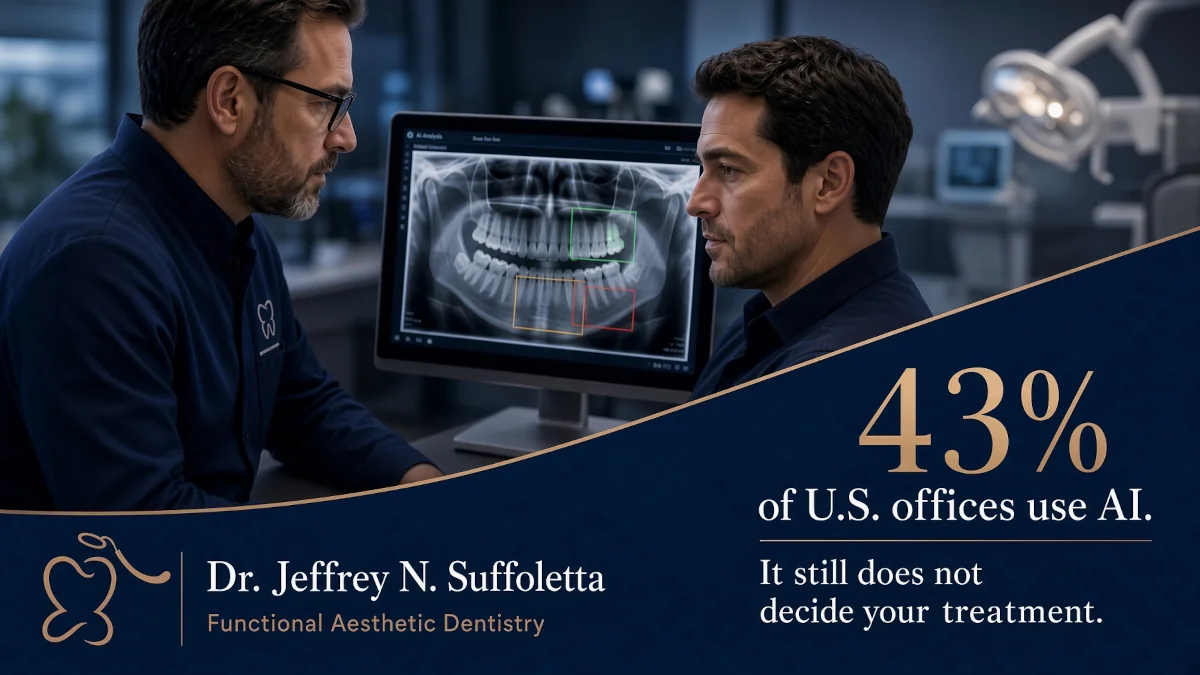
That is the plain reading of the American Dental Association Health Policy Institute’s mid-2026 survey of practicing dentists, published with the Q2 2026 State of the U.S. Dental Economy update. Among respondents, 43.3% said they already use AI for at least one task in the practice. Another 26.4% are not using it yet but plan to. 30.3% neither use it nor intend to. Becker’s Dental Review, summarizing the same HPI work, reported that the panel included more than 500 private-practice dentists.
The split is the story. Adoption is real. Clinical authority is not being handed over.
Where the software actually sits
HPI found dentists in US Dental Offices are using AI first as a helper on images and as a clerk on paperwork—not as a doctor.
Imaging and diagnostics is the largest clinical use: 22.8% of respondents. That usually means a program reads bitewings or periapical films and boxes possible cavities, bone loss, calculus, or a dark spot at a root tip. The dentist still opens the image.
Administrative uses cluster just behind. 13.6% use AI for insurance verification. 13.2% use it to help explain findings to patients. About one in ten use it for social media (10.7%), practice analytics (10.1%), or front-desk check-in (10.1%). Scheduling and billing each sit near 9%. Charting and note-taking, often marketed as the next big win, is only at 7.4% among current users.
HPI’s own summary was blunt, when the question turns to clinical decision making, AI’s footprint is small. Fewer than 5% of dentists said they currently use AI for patient treatment recommendations.
The line most dentists will not cross
Asked about the future, respondents were even clearer about what they will not automate.
82.6% said they do not plan to use AI for treatment recommendations. 68.3% do not plan to use it to explain clinical findings to patients. A majority also said they have no plan to use AI for imaging, even though imaging is the most common current clinical application. HPI and secondary write-ups of the same tables put that “no plan” share for imaging at about 54%.
The planned next wave is not a robot dentist. It is the inbox. Among dentists not using AI today, 34.8% expect to use it for charting and notes, 32.6% for insurance verification, and 25.4% for imaging. Billing and claims (29.7%) and analytics (27.2%) follow. That matches a profession that has spent years naming insurance hassles, documentation, and staffing as top practice problems.
Optimism is limited. Becker’s, citing the same report, said more than 20% of dentists were optimistic about AI’s potential in dentistry and nearly 14% were generally opposed. The rest sit in the large middle, willing to try a tool that saves minutes, unwilling to let it pick a crown versus a filling.
What that looks like in the chair
For a patient, the difference is easy to miss and easy to overread.
You may see colored overlays on an X-ray, a list of “findings,” or a tablet animation of bone levels. Some offices use those pictures to walk through why a filling is being recommended. Some insurers already use similar software on the claims side to review radiographs. FDA-cleared dental imaging systems from companies such as Pearl, Overjet, and VideaHealth have been on the market for several years as Class II devices. Clearance means the agency accepted the product as substantially equivalent for a defined use—typically to aid a licensed dentist, not to replace one.
That last clause is the one that matters in the operatory. A box around a shadow is a prompt. It is not a diagnosis. Two dentists can still disagree about whether a stain is a cavity that needs a drill this year. An algorithm does not end that argument. It can make the argument faster, or louder, or easier to show a patient. It can also flag things a tired eye misses at 4:45 p.m. on a Friday.
The legal and ethical default has not changed. The dentist who bills the visit owns the diagnosis, the recommendation, the record, and the conversation. HPI’s numbers suggest most dentists want to keep it that way.
Washington and the standards groups are treating this as infrastructure, not science fiction
The ADA is not waiting for a single product to settle the field. In February 2026 the Association answered an HHS request for information on health-sector AI. ADA President Richard Rosato and Interim Executive Director Elizabeth Shapiro wrote that adoption is uneven, especially in small and rural offices that face weak broadband, thin IT staffs, high upfront cost, and unclear rules about which tools are medical devices. They pointed to ADA Technical Report No. 1109 on evaluating image-analysis systems and argued for independent validation so tools are not accepted on vendor slides alone.
Standards work is already on the books. ANSI/ADA Standard No. 1110-1:2025 covers how 2D radiographic datasets should be annotated and collected for image-analysis AI. White Paper 1106 (2022) mapped clinical and payer uses. The Association has also discussed “fact labels” for models so a practice can see intended use, training data limits, and what the tool is not cleared to do.
None of that is a ban. It is an admission that “AI read my X-ray” is now a product category that needs the same boring discipline as an autoclave log: what it does, who checked it, and who is still responsible.
Three numbers patients can use
- First: four in ten offices in this survey already have some AI running. Asking “Do you use AI on X-rays?” is no longer an odd question.
- Second: almost nobody in the survey lets AI choose treatment. If a printout or a portal message sounds like the computer decided you need a root canal, ask who reviewed the film.
- Third: three in ten dentists are sitting this out. That is not proof they are more careful. It may mean they are small, rural, late-career, or unconvinced the subscription is worth it. It does mean AI is not yet a standard of care in the way fluoride or gloves are.
What a serious office should be able to answer
Does a dentist review every AI-flagged finding before it is shown as a diagnosis? Is the imaging tool FDA-cleared for that use and that age group? Where do the images live after they leave the sensor—on a clinic server, or in a vendor cloud? Can a patient decline the overlay and still get a human read? If the software and the dentist disagree, whose note goes in the chart?
Those questions are more useful than a vibe about “the future of dentistry.” HPI’s 2026 snapshot is not a prediction that AI will stay in the back office. It is a measurement of where dentists drew the line this year: yes to highlighting a shadow and filling out a claim, no to picking the treatment. Until that line moves, the person who should decide whether your tooth is watched, filled, or crowned is still the one holding the mirror.
Related Article:
- Why the ADA is Calling Out Dental Insurance
- Why We’re Doubling Down on New Oral Cancer Standards
- Do You Really Need a Whole-Body Dentist?
- Sleep-Focused Dentistry
We look forward to seeing you at your next visit! If you need to schedule an appointment or have a question, give us a call today.