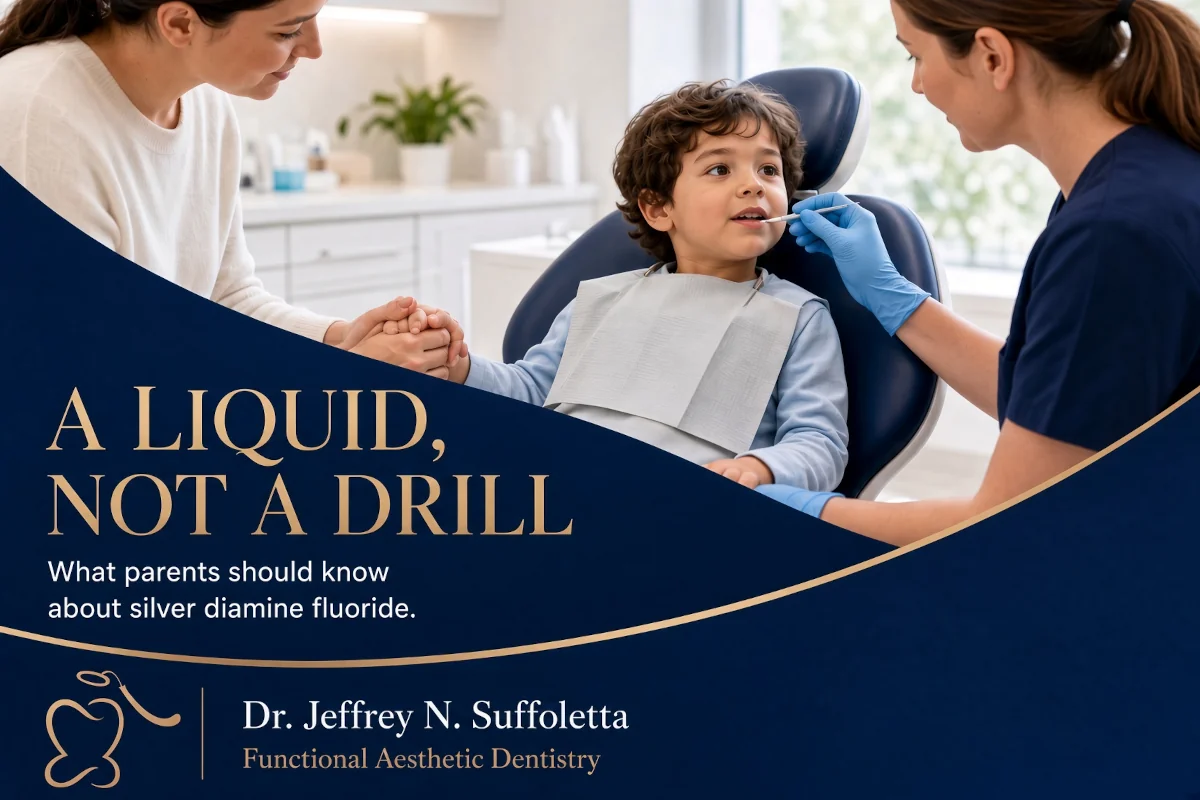
A Liquid, Not a Drill. What is Silver Diamine Fluoride?
Tooth decay is still the most common chronic disease of childhood in the United States. It affects more than 40% of American children. When cavities in baby teeth get deep, the usual options are a shot and a drill, a stainless-steel crown, or when a toddler cannot sit still, treatment under general anesthesia. Those paths work. They are also expensive, stressful, and, for some families, out of reach. What’s the new alternative option? Let’s get into silver diamine fluoride.
A large 2026 U.S. clinical trial says there is another option for many of those baby teeth: a liquid painted onto the cavity in about ten seconds. No drill, injection or operating room.
The liquid is 38% silver diamine fluoride, or SDF. Dentists have used versions of it internationally since the 1970s. The World Health Organization added it to its essential medicines list in 2021. In the United States, the Food and Drug Administration cleared SDF in 2014 as a treatment for tooth sensitivity in adults. Using it to stop cavities in children has been legal but off-label, common in pediatric dentistry, unevenly covered by insurance, and short on the kind of large American trial regulators like to see. That gap is what the new study was built to close.
What the Michigan-led trial actually tested
On July 27, 2026, JAMA Pediatrics published a Phase III randomized trial led by Dr. Margherita Fontana, a professor at the University of Michigan School of Dentistry. Co-investigators included teams at New York University, the University of Iowa, and Indiana University. The National Institute of Dental and Craniofacial Research funded the work with more than $12 million.
The study enrolled 830 generally healthy children, ages 12 to 71 months, all with severe early childhood caries, aggressive decay that had already opened into dentin, the softer layer under enamel. Children were recruited from dental offices, pediatric medical clinics, and Head Start and Early Head Start programs in Michigan, New York, and Iowa. Kids with developmental or intellectual disabilities were allowed in if they could cooperate enough for a brief application.
Each child was assigned at random to either Advantage Arrest 38% silver diamine fluoride or a look-alike placebo (tinted water). A clinician cleaned the cavity with a toothbrush or microbrush, dried it, painted the liquid on for about 10 seconds, and blotted it dry. There was no drilling and no removal of decayed tooth structure. Treatment was given at the first visit and again at six months. Examiners checked the teeth at 3, 6, and 8 months and scored whether each cavity had hardened—the definition of “arrest.”
The trial started in 2018 and ran through the pandemic. About 30% of children were lost to follow-up, nearly 10% because of COVID-19. Researchers still analyzed the full enrolled group using standard intent-to-treat methods. Enrollment stopped early at 830 children, short of a larger original target, because the benefit was already clear.
The numbers parents should remember
At six months after a single application, silver diamine fluoride arrested 54.0% of treated cavities. Placebo arrested 22.5%. The difference was 31.5 percentage points. At three months the gap was even larger: 57.5% versus 18.8%. At eight months, after a second application, SDF still led, 50.2% versus 17.4%.
That is more than twice the arrest rate of doing nothing beyond the placebo visit. It is also not a miracle. Roughly half of the cavities in these high-risk children were not stopped. Fontana’s team was explicit about that: SDF belongs next to fluoride, diet changes, and regular exams—not instead of them. Children still need follow-up. Some will still need a filling or a crown.
Pain scores did not differ between groups. Overall side effects were similar: 47.3% of children in the SDF group and 43.3% in the placebo group had some reported event, most of them mild or moderate, and many of them the toothaches and abscesses you already expect in kids with severe decay. Treatment-related events were almost identical (22.9% vs. 22.2%). About 7.5% in each group stopped because of side effects. Extraoral staining—dark marks on lips or skin from a drip—showed up in 2.4% of SDF children and none of the placebo children. Those marks fade. The stain on the tooth does not.
“This is a very effective and safe treatment—even in children as young as 1,” Fontana said. She has also said that for almost anyone, silver diamine fluoride can arrest decay and stop the infection and pain it causes.
How the silver diamine fluoride liquid works
SDF is a clear, high-pH solution of silver and fluoride. The silver is antimicrobial. The fluoride helps the remaining tooth mineral harden. Together they can freeze an active cavity in place so it stops spreading toward the nerve. The treated spot turns dark because silver byproducts precipitate in the decayed tissue. Healthy enamel does not blacken the same way. The color is the visible proof that the chemistry happened.
Application is quick. A child does not need to hold still for a filling. That is why pediatric dentists have used SDF for very young children, children with special health care needs, patients with severe dental anxiety, and families who cannot get into an operating room on a reasonable timeline.
The tradeoff every parent should see before they say yes
The darkened cavity is permanent on that tooth. On a back baby molar that will fall out in a few years, many parents accept it immediately. On a front tooth in a three-year-old’s smile, many do not. Surveys in other SDF research have found that a substantial minority of parents will refuse SDF no matter the alternative; others will accept a dark front tooth if it avoids general anesthesia.
Ask to see photos of treated teeth before you consent. Ask which teeth the dentist wants to treat. You can say yes to back teeth and no to front teeth. You can also use SDF as a bridge: stop the decay now, restore the tooth later when the child can tolerate a filling.
SDF will stain clothes, counters, and skin if it drips. Clinics isolate the tooth for that reason. A metallic taste lasts a few minutes. SDF is not used on teeth that are already abscessed, on teeth that need to be extracted, or as a substitute for care when a child’s face is swollen. Infection that has left the tooth still needs definitive treatment.
Why the FDA label still matters at the front desk
The FDA granted SDF breakthrough therapy status for caries arrest in 2016. This trial was designed to support a formal drug claim for stopping cavities in children ages 1 to 6 with severe early childhood caries. Until that label changes, many offices still code and bill SDF in a patchwork way. NYU’s Dr. Amr Moursi, a co-principal investigator, said taking SDF off off-label status could increase use, improve insurance payment, and steady product quality.
Coverage varies by plan and by state Medicaid program. Ask before the visit whether SDF is a covered service and whether a later filling on the same tooth would still be covered.
Questions worth asking on silver diamine fluoride
Is this cavity a good SDF candidate, or does the tooth already need a crown or extraction? Will you treat only baby teeth, or is an adult tooth involved? How often will you reapply, every six months, or sooner? What happens if the spot does not harden at the next check? Can we restore the tooth later for appearance? What should we change at home so new cavities do not form next to the treated ones?
SDF will not replace the toothbrush, the bedtime bottle problem, or the juice cup. The children in this trial already had severe disease. The liquid bought time and spared many of them a drill. It did not rewrite the rest of prevention.
If your child has cavities, the useful question is not “Is SDF good?” It is “For this tooth, in this child, is a stained, hardened baby tooth better than a filling, a crown, or a wait-and-watch plan?” That is a conversation with photos, not a slogan. The 2026 trial gives parents something they did not have at this scale. U.S. evidence that the liquid works more than twice as often as placebo, that it is generally well tolerated, and that it still requires a dentist who will look again in a few months.
Related Article:
- All About Same-Day Dental Crowns
- Beyond Fluoride: The 2026 Peptide Revolution in Enamel Repair
- Breakthrough Biodegradable Fillings Could Transform Cavity Treatment
- How to Get Your Kids on a Perfect Dental Routine in 5 Minutes
We look forward to seeing you at your next visit! If you need to schedule an appointment or have a question, give us a call today.