Why We’re Doubling Down on New Oral Cancer Standards
More Than Just a Checkup
When you sit down in the dental chair for your regular cleaning, you probably expect us to check for cavities and see how your gums are doing. That is a huge part of what we do, of course. But there is another part of your exam that is even more critical, one that literally saves lives.
We are talking about oral cancer screenings.
In April 2026, the American Dental Association (ADA) released a significant update to their clinical guidelines regarding the early detection of oral cancer. As a practice dedicated to “Whole-Health” dentistry here in Summerlin and Las Vegas, we want to share what these new standards mean for you and why we are doubling down on our commitment to thorough, hands-on clinical exams.
What Changed in April 2026?
For years, the dental industry has explored different “adjunct” tools to help find oral cancer. You may have heard of or even experienced “vital staining.” This is a process where a dentist uses a specific dye (often a blue stain) in the mouth to see if certain tissues “take up” the color. The theory was that cancerous or precancerous cells would look different when dyed.
However, the latest ADA Living Guideline Program recommendations have taken a firm stand based on the most recent evidence. The research now shows that these staining techniques are not as reliable as we once hoped. In fact, they can sometimes lead to “false positives” or, worse, a false sense of security.
As a result, the new 2026 standards prioritize a comprehensive clinical exam, performed by a trained professional, over these staining adjuncts. At Functional Aesthetic Dentistry, we’ve always believed that technology should support, not replace, a dentist’s clinical expertise. This update confirms that our focus on manual and visual screenings is the gold standard for your safety.
Why Early Detection is a Game Changer
Oral cancer is often called a “silent” disease. In its earliest stages, it rarely hurts. You might not even notice a change in your mouth when looking in the bathroom mirror. Unfortunately, many cases of oral cavity and oropharyngeal cancers are not caught until they have reached an advanced stage.
When found early, the survival rate for oral cancer is significantly higher, and the treatment is much less invasive. By sticking to the most rigorous oral cancer screening standards, we are giving our patients the best possible chance at a healthy outcome.
The “Whole-Health” Connection
You might wonder why a dentist is so concerned with cancer screening. Isn’t that a job for a primary care doctor?
This is where the concept of “Whole-Body” or “Whole-Health” dentistry comes in. At our practice, we don’t view your mouth as an isolated part of your body. Your oral health is deeply connected to your systemic health. Inflammation in the mouth can affect the heart; bacteria in the gums can impact your lungs; and signs of systemic diseases, like cancer, often show up in the mouth first.
Because you likely see your Summerlin dentist more often than you see your primary care physician, we are on the front lines of your overall wellness. When we perform an oral cancer screening, we aren’t just looking at your teeth; we are looking at the “whole you.”
What a “Doubled Down” Exam Looks Like
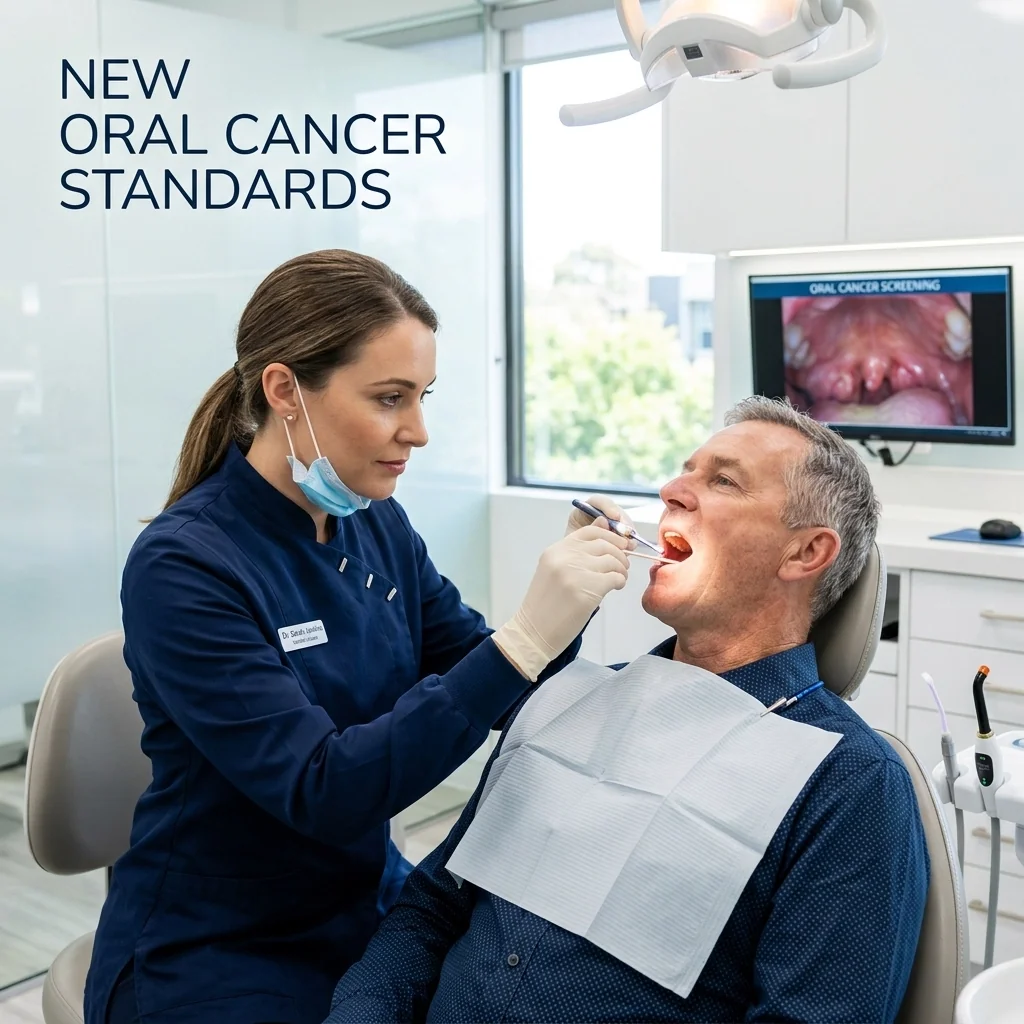
Since the ADA is now emphasizing the clinical exam over dyes and stains, we want you to know exactly what to expect during your visit. A truly thorough screening isn’t just a ten-second glance. It involves a systematic approach:
- Visual Inspection: We look at your lips, the inside of your cheeks, the roof of your mouth, and the back of your throat. We use high-quality lighting to spot any color changes, like white or red patches.
- The Tongue Check: This is one of the most common areas for oral cancer. We will gently hold your tongue with gauze to check the sides and the very back, areas that are hard to see on your own.
- Manual Palpation: This is the “hands-on” part. We feel the floor of your mouth and along your jawline. We are looking for lumps, bumps, or areas of thickness that shouldn’t be there.
- The Neck and Lymph Nodes: Oral cancer often spreads to the lymph nodes in the neck. A comprehensive exam includes feeling the structures of your neck to ensure everything feels normal and healthy.

Common Signs and Symptoms to Watch For
While we perform these screenings during your general dentistry visits, you are the best advocate for your own health between appointments. If you notice any of the following persisting for more than two weeks, please give us a call:
- A sore or ulcer that does not heal.
- Red or white patches on the gums, tongue, or lining of the mouth.
- Unexplained bleeding in the mouth.
- A persistent lump or thickening of the tissues.
- Difficulty swallowing or a feeling that something is “caught” in your throat.
- Numbness or pain in any area of the mouth or lips.
Remember, having one of these symptoms doesn’t automatically mean you have cancer. Many minor issues, like a canker sore or a bit of trauma from crunchy food, can cause similar signs. However, the “two-week rule” is a great way to decide when it’s time to get a professional opinion.
Why We Advocate for Our Summerlin Neighbors
Las Vegas is a vibrant place to live, but the “hustle and bustle” can sometimes make us put our health on the back burner. We see patients from all over the valley who are busy with work, family, and life. Our goal is to make these life-saving screenings a seamless part of your preventive care.
The April 2026 guidelines remind us that being a dentist in the modern age means being a constant student. Science evolves, and as it does, our methods must evolve too. By moving away from older “staining” methods and leaning into the “Living Guideline” model, we ensure that every patient in our chair receives care based on the most current, proven data available.
The Technology We STILL Use
Even though the ADA is moving away from vital staining as a primary screening tool, that doesn’t mean we’ve abandoned technology. We still use advanced digital imaging and high-definition intraoral cameras to document any suspicious areas. This allows us to track changes over time and share high-resolution images with specialists if a referral is ever needed.
The “Whole-Health” approach means we use the best of both worlds: the human touch and expert clinical judgment, supported by the latest digital tools.
Taking Charge of Your Health
We know that “cancer” is a heavy word. It can be scary to think about. But our mission is to empower you through knowledge and proactive care. When you know that your dental team is looking out for your entire well-being: not just your smile: it brings a level of peace of mind that you can’t get anywhere else.
If it has been a while since your last checkup, or if you’ve never had a formal oral cancer screening, now is the perfect time to schedule. We are proud to serve the Las Vegas and Summerlin communities with a “Functional” approach that keeps you healthy from the inside out.
Summary Checklist for Your Next Visit:
- Ask about the screening: Don’t be afraid to ask, “Can you walk me through my oral cancer screening today?”
- Share your history: Tell us if you use tobacco, drink alcohol frequently, or have a family history of cancer.
- Mention any changes: If you’ve noticed a weird spot or a persistent sore, let us know right away.
Your health is our priority. Let’s work together to make sure your smile stays as healthy as it is beautiful.