Same Day 3D-Printed Crown Are About to Get Stronger
If you have ever worn a temporary crown, you already know the weak middle chapter of traditional dentistry. The tooth is shaped. A mold or a scan goes to a laboratory. You leave with a thin plastic cap and a list of foods to avoid. Two weeks later you come back, hope the temporary is still on, and the permanent crown is cemented. Most of the time that system works. The parts patients remember are the second appointment, the numb lip twice, and the week the temp popped off on a bagel.
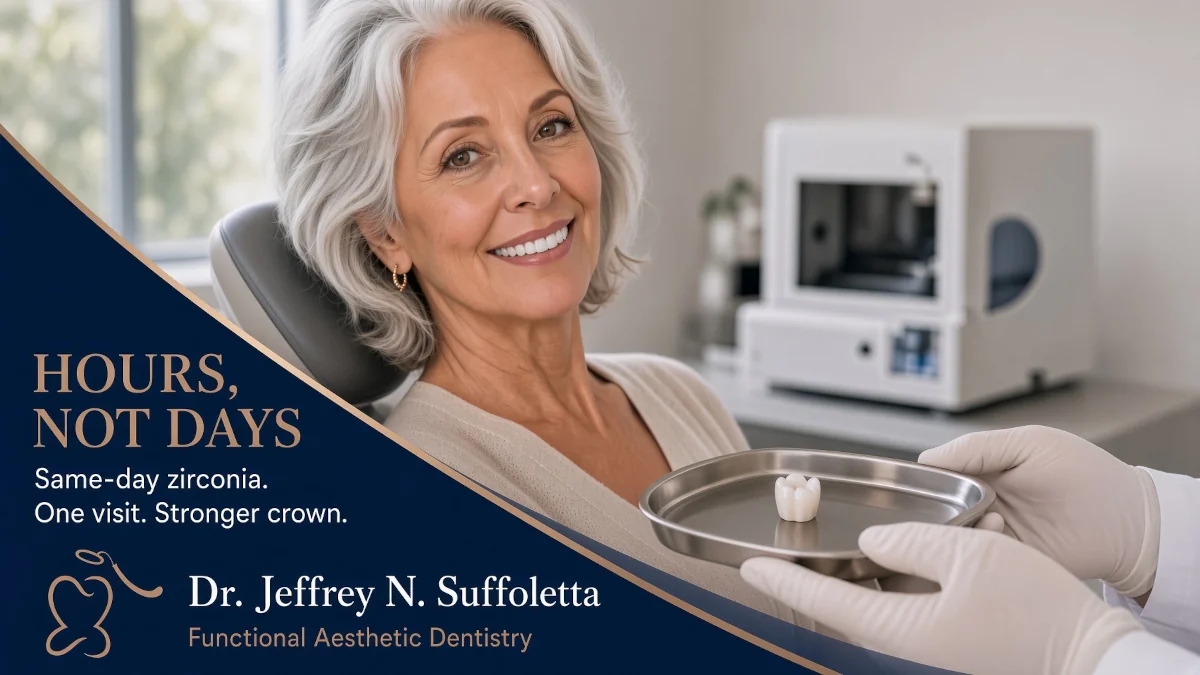
Same-day 3D-printed crown already exist. In offices with chairside CAD/CAM mills—CEREC is the name many people know—the dentist can scan the tooth, design the cap on a screen, and carve it from a solid ceramic block while you wait. The whole visit is often 90 minutes to three hours. You leave with a permanent restoration, not a placeholder. Those milled crowns are usually lithium disilicate or zirconia. They are not experimental. They have years of clinical use behind them.
What has been missing is a different manufacturing path, a permanent zirconia crown that is 3D-printed in the office and finished in a few hours, not milled from a factory block and not shipped from a lab. That is the claim coming out of engineering labs in 2025 and 2026. It is promising. It is not, yet, the crown you should assume is sitting in every practice down the street.
Why zirconia is the material people keep chasing
Zirconia is a ceramic used for crowns, bridges, and implant abutments because it is strong, tooth-colored, and kind to gum tissue. Full-contour zirconia is a workhorse on back teeth that take heavy bite force. Strength figures for zirconia are often cited around 1,000 megapascals or more, well above many glass ceramics. Patients do not buy megapascals. They buy a crown that does not crack on a pistachio and does not flash a gray line at the gum.
Laboratories already print and mill zirconia every day. The catch for same-day care has never been “can zirconia be shaped?” It has been “can you take a printed zirconia part from a vat of ceramic resin to a dense, sinter-fired crown before the patient gets hungry?”
A zirconia 3D printed crown usually starts with vat photopolymerization. A printer builds the crown layer by layer from a slurry of zirconia particles held in a polymer binder. Fresh off the printer, that object is not a crown. It is a fragile green body. The binder has to be burned out—debinding—and then the ceramic particles have to be fused at very high heat—sintering, the same idea as firing clay in a kiln. Rush the burnout and the polymer turns into gas trapped inside the part. The crown cracks. Go slow and the furnace cycle can run 20 to 100 hours. That is fine for a production lab. It is useless if the patient is in the reception area.
What University of Texas at Dallas changed
Mechanical engineers at UT Dallas, led by Dr. Majid Minary, reported a way to collapse that burnout step. First author Mahdi Mosadegh and colleagues described single-step thermal debinding for ceramics vat photopolymerization in less than 30 minutes in Ceramics International. The paper’s 2025 volume drew wider attention in 2026 as science outlets framed it as a path to same-day printed zirconia.
The method is a thermal protocol, not a magic new powder. Porous graphite felt wraps the printed crown and can exceed 2,550°F (about 1,400°C). Heat moves into the part more evenly. Gases from the burning binder have somewhere to go. A vacuum pulls those gases off so they do not blow the ceramic apart. “Debinding has been the bottleneck in the process,” Minary said. “It must be done very slowly. If you speed it up, the polymer being burned off turns into gas, and if that gas cannot escape, the crown may crack or fracture. A debinding time of 20 to 100 hours is not practical for same-day dental service.”
With the new cycle, he said a practitioner could offer a chairside zirconia 3D printed crown within a few hours. That “few hours” still includes printing, the shortened burnout, sintering, finishing, and cementation. It is not a 10-minute party trick. It is a compressed lab day moved next to the operatory.
The work has National Science Foundation support for technology translation, including a reported $550,000 award, plus backing from the U.S. Air Force Office of Scientific Research. Commercial partners named in coverage include Pan-AM Dental Laboratory and 3DCeram Sinto. The intended menu is not only single crowns. The same pipeline could apply to bridges and veneers if the ceramics survive the heat and the fit holds up in mouths, not just furnaces.
What a zirconia 3D printed crown is not
It is not an FDA-cleared, off-the-shelf chairside printer you can order this month and start seating printed zirconia after lunch. The researchers and the coverage are clear, clinical validation and regulatory approval still sit between the journal article and a routine patient visit.
It is also not the same thing as the printed resin crowns already entering some offices. Companies have cleared or marketed additively manufactured “permanent” crown resins that print in minutes and cost little in raw material. Those resins are not zirconia. They are not lithium disilicate. Speed and price are real. So is the difference in how the material behaves under years of chewing, staining, and grinding. A 2026 esthetic-dentistry paper on 3D-printed zirconia also noted that printed zirconia can be less translucent than milled zirconia of the same family because of microstructure. For a back molar, that may not matter. For a front tooth in a high-smile patient, a lab technician layering porcelain may still win.
Milled same-day zirconia already solves the “I don’t want two visits” problem for many single teeth. Printing’s theoretical advantages are different: more complex internal geometry, less waste than carving a block, and—if the heat cycle is truly office-friendly—a permanent high-strength ceramic without a lab slip. Milling can leave tool marks and, in some protocols, micro-cracks. Printing has its own defects if layers fail or sintering is uneven. Neither method forgives a sloppy scan or a tooth prepared without a clear margin.
What a patient actually feels in 2026
Walk into a well-equipped office today and the realistic same-day story is still this. You are numb. The old filling or broken cusp comes off. The tooth is shaped for a cap. A wand scans the tooth and the bite. Software designs the crown. A mill cuts a block for 10 to 40 minutes while you wait. The dentist tries it in, adjusts the bite, polishes or glazes, and bonds it. You chew on the other side that night and treat it as a real tooth within the instructions you are given.
The two-visit lab story is still the right one when the case is a front tooth that needs custom shading, a bridge, an implant crown with a difficult emergence profile, or a mouth that needs the technician’s articulator and extra time. Same-day dentistry is a workflow. It is not a moral upgrade. A rushed mill with a high bite is worse than a two-week lab crown that fits.
If printed zirconia arrives in clinics, the patient-facing change will look familiar: one longer appointment instead of two shorter ones, no temporary, a ceramic chosen for strength. The new sentence will be that the cap was grown in a printer and fired in a fast furnace rather than carved from a puck.
Questions worth asking before you sit down
Is my crown being milled today, printed in resin, sent to a lab, or—if the office ever offers it—printed in zirconia? Which material is recommended for this specific tooth, and why? How long have you been using this workflow, and what do you do if the first crown does not seat? Will a temporary still be needed if the furnace cycle runs long? Does my insurance treat a same-day ceramic the same as a lab ceramic? For a visible front tooth, is a layered lab crown the more honest aesthetic plan?
A crown fails at the margin, the bite, or the cement line more often than it fails because the factory used a mill instead of a printer. The UT Dallas work matters because it attacks a real bottleneck: zirconia’s strength with printing’s geometry, on a clock patients will accept. Until that process is cleared and proven in everyday practice, “same-day crown” still means a scan, a mill, and a dentist who will not send you home with a temp if the fit is not right.
The headline is fair. Same-day crowns are about to get stronger if the heat cycle scales, the printers stay accurate, and regulators and clinicians agree the ceramic in the mouth matches the ceramic in the paper. The appointment you book this year should be judged by the tooth you have, not by a furnace time in Dallas.
Related Article:
- All About Same-Day Dental Crowns
- Same-Day Care and Precision Dentistry in 2026
- The ‘Chairside Zirconia’ Era
- Same-Day Crowns vs Traditional Crowns
We look forward to seeing you at your next visit! If you need to schedule an appointment or have a question, give us a call today.