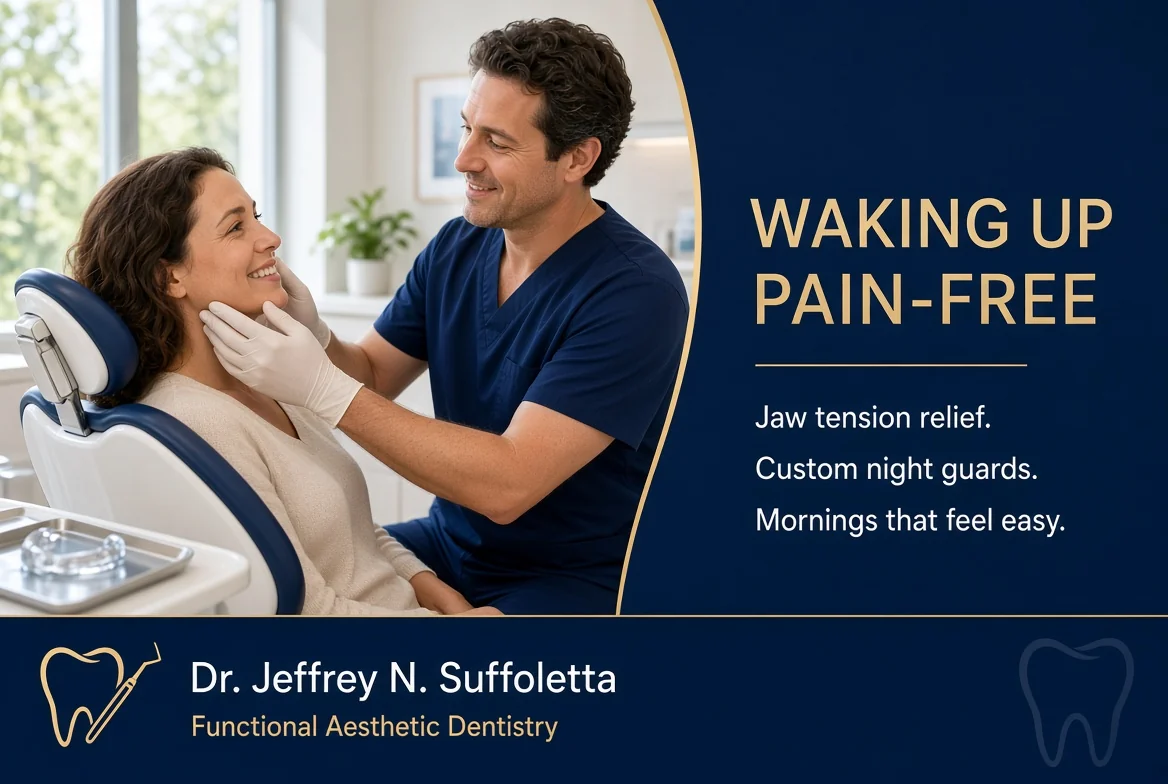
Waking Up TMJ Pain-Free
Do you ever wake up feeling like you’ve been clenching your teeth all night long? Maybe you notice a dull ache in your temples, a tightness in your neck, or a jaw that feels like it’s “stuck” until you move it around a bit. In our office, we often call this the “TMJ Pain” or comedically, “jaw hangover.” You didn’t stay out late on the Strip, but you woke up feeling like your face did a heavy workout while you were sleeping.
At Functional Aesthetic Dentistry, we see many patients in Las Vegas and Summerlin who struggle with this exact problem. While many people think a sore jaw is just a sign of a stressful week, it’s often a signal that something deeper is going on with your Temporomandibular Joint (TMJ).
The good news? You don’t have to live with it. By identifying the root cause of your tension, we can help you move from “waking up tired” to “waking up refreshed.”
What Exactly is the TMJ?
Before we dive into why it hurts, let’s look at the mechanics. Your TMJ is the joint that connects your jawbone to your skull. It’s one of the most complex joints in your body because it doesn’t just open and close like a door hinge; it also slides forward, backward, and side-to-side.
This joint is surrounded by a network of muscles, nerves, and a small cushioning disc that keeps everything moving smoothly. When this system is in balance, you don’t even think about it. You eat, speak, and yawn without a second thought. However, when things get out of alignment: a condition known as Temporomandibular Disorder (TMD): those muscles start to overwork. Consequently, you experience pain that can radiate into your ears, neck, and even down your shoulders.
Why Do You Wake Up with TMJ Pain?
If you feel the most discomfort first thing in the morning, the culprit is almost always something happening while you sleep. Most often, this is bruxism, which is the medical term for grinding or clenching your teeth.
The Sleep Bruxism Cycle
Our mouth is full of bacteria and complex structures, but at night, it becomes a battlefield for stress. Studies show that many people clench their teeth as a physical response to daily stress or anxiety. You might not even know you’re doing it until a dentist notices the wear on your teeth or you start feeling that morning tightness.
When you clench, you are putting hundreds of pounds of pressure on your teeth and the TMJ. Imagine holding a heavy dumbbell in your hand all night; your arm would be exhausted and sore in the morning. Your jaw muscles are no different.
Other Contributing Factors
- Bite Misalignment: If your teeth don’t fit together perfectly (your “occlusion”), your jaw muscles have to work extra hard to find a comfortable resting place.
- Sleep Apnea: Interestingly, clenching can sometimes be a sign of a sleep-disordered breathing issue. Your body may clench the jaw to keep the airway open during the night.
- Inflammation: Conditions like arthritis can affect the jaw joint just like they affect the knees or hips, leading to stiffness in the morning.
Finding the Root Cause of TMJ Pain
At Functional Aesthetic Dentistry, we don’t believe in just “treating the symptoms.” If we only give you a generic store-bought mouthguard, we might protect your teeth from wearing down, but we aren’t necessarily stopping the tension.
Our approach is different because we look at the function and the aesthetics of your smile as one unified system. When you visit our Summerlin dental office, we perform a comprehensive evaluation that includes:
- Digital Scanning: We use advanced technology to see exactly how your teeth meet. This helps us identify “high spots” or misalignments that might be triggering your jaw muscles to stay active.
- Muscle Palpation: We feel the muscles in your face and neck to find trigger points: those “knots” that keep the tension locked in place.
- Joint Assessment: We listen for clicking or popping and check your range of motion to see if the internal disc of the joint is displaced.
- Airway Screening: Since sleep and jaw health are linked, we check for signs that your jaw tension might be related to how you breathe at night.
Our Solutions for a Pain-Free Morning
Once we identify why your jaw is under stress, we create a tailored plan to help you find relief. Fortunately, most TMJ issues can be managed with conservative, non-invasive treatments.
Custom-Fitted Night Guards (Orthotics)
Not all night guards are created equal. The “boil-and-bite” versions you find at the drugstore are often too soft, which can actually encourage your brain to “chew” on them, making clenching worse.
A custom TMJ treatment appliance from our office is made of high-quality, durable materials. It is designed to hold your jaw in a “neutral” position where the muscles are at their longest and most relaxed. This allows the joint to rest and heal while you sleep.
Botox for TMJ Pain Relief
For patients with extreme muscle tension, we sometimes recommend Botox treatments. While many people think of Botox only for wrinkles, it is a powerful tool for relaxing the masseter muscles (the big muscles on the side of your jaw).
By injecting small amounts into the overactive muscles, we can “turn down the volume” on the clenching. It doesn’t stop you from chewing or talking, but it prevents the intense, unconscious clenching that leads to headaches and jaw pain. This treatment usually lasts 3-4 months and can be a life-changer for chronic sufferers.
Lifestyle and Physical Therapy
We also provide practical recommendations for home care. This might include:
- The “Lips Together, Teeth Apart” Rule: Training yourself to keep your teeth from touching during the day.
- Moist Heat: Using a warm compress to relax the muscles before bed.
- Dietary Adjustments: Avoiding very chewy or hard foods (like gum or tough steak) while your joint is healing.
Why It Matters: More Than Just a Sore Jaw
Ignoring TMJ issues can lead to long-term problems that go beyond discomfort. Over time, chronic clenching can lead to:
- Cracked or Broken Teeth: The pressure can eventually cause teeth to fracture, requiring crowns or implants.
- Gum Recession: Excessive force on the teeth can actually cause the gums to pull away.
- Chronic Migraines: Many “tension headaches” are actually undiagnosed TMJ issues.
- Ear Pain: Because the joint is so close to the ear canal, inflammation often feels like an earache.
By addressing the issue now, you are protecting your overall general dentistry health and ensuring your smile remains beautiful and functional for years to come.
Frequently Asked Questions
1. Will my TMJ pain go away on its own?
Sometimes, minor jaw tension caused by a temporary stressful event will resolve itself. However, if you have been experiencing pain for more than a few weeks or if your jaw is clicking and locking, it is important to see a professional to prevent permanent joint damage.
2. Does insurance cover TMJ treatment?
Coverage varies depending on your specific plan. Our team at Functional Aesthetic Dentistry is happy to help you navigate your benefits and find a payment plan that works for you.
3. How long does it take to feel better?
Many patients feel a significant difference within the first week of wearing a custom night guard. Botox treatments typically take 3 to 7 days to start working.
4. Ready to Wake Up Refreshed?
If you’re tired of the “jaw hangover” and ready to find a real solution, we’re here to help. Our team in Las Vegas and Summerlin is dedicated to providing compassionate, high-tech care that gets to the heart of the problem.
Call us today to schedule your TMJ consultation and take the first step toward waking up pain-free!
Related Articles:
We look forward to seeing you at your next visit! If you need to schedule an appointment or have a question, give us a call today.