Understanding Oral Appliance Therapy for Sleep Apnea
Continuous positive airway pressure is still the treatment with the strongest track record for obstructive sleep apnea. A mask, a hose, and a bedside machine hold the airway open with air. When the device is worn for the night, oxygen stays up and the pauses that define apnea get fewer. The catch is in that first clause. Treatment only counts if it is used. A machine on the nightstand is not therapy.
A large share of people who are prescribed CPAP do not wear it for the hours their clinician wants. Mask leaks, a dry mouth, a feeling of being trapped, a partner who can hear the motor, a job that lives out of a suitcase—any one of those can end the experiment. Oral appliance therapy is the option many of those patients are never told about in the sleep clinic, and the one a dentist should not start without the sleep clinic.
Why the mask loses
The complaints are ordinary, which is why they get minimized. A full-face mask rubs the bridge of the nose. Nasal pillows sting if the nose is already congested. Heated humidity helps dryness until the chamber is left empty on a trip. Claustrophobia is not a preference; some people will not fall asleep with something strapped to the face, full stop. Shift workers and frequent flyers get tired of packing a machine that may not have an outlet that works. Others wear it for two hours, pull it off, and wake up with the same headache.
None of that means CPAP failed as medicine. It means this patient and this device are not a match. Guidelines from dental sleep medicine groups, including the American Academy of Dental Sleep Medicine, are explicit on the next step: people who are doing well on positive airway pressure should stay on it. People who cannot tolerate it, who have already failed a real trial, or who prefer another proven option should be offered something they might actually use. An oral appliance is that option for many of them. It is not a consolation prize made of plastic.
What the appliance is
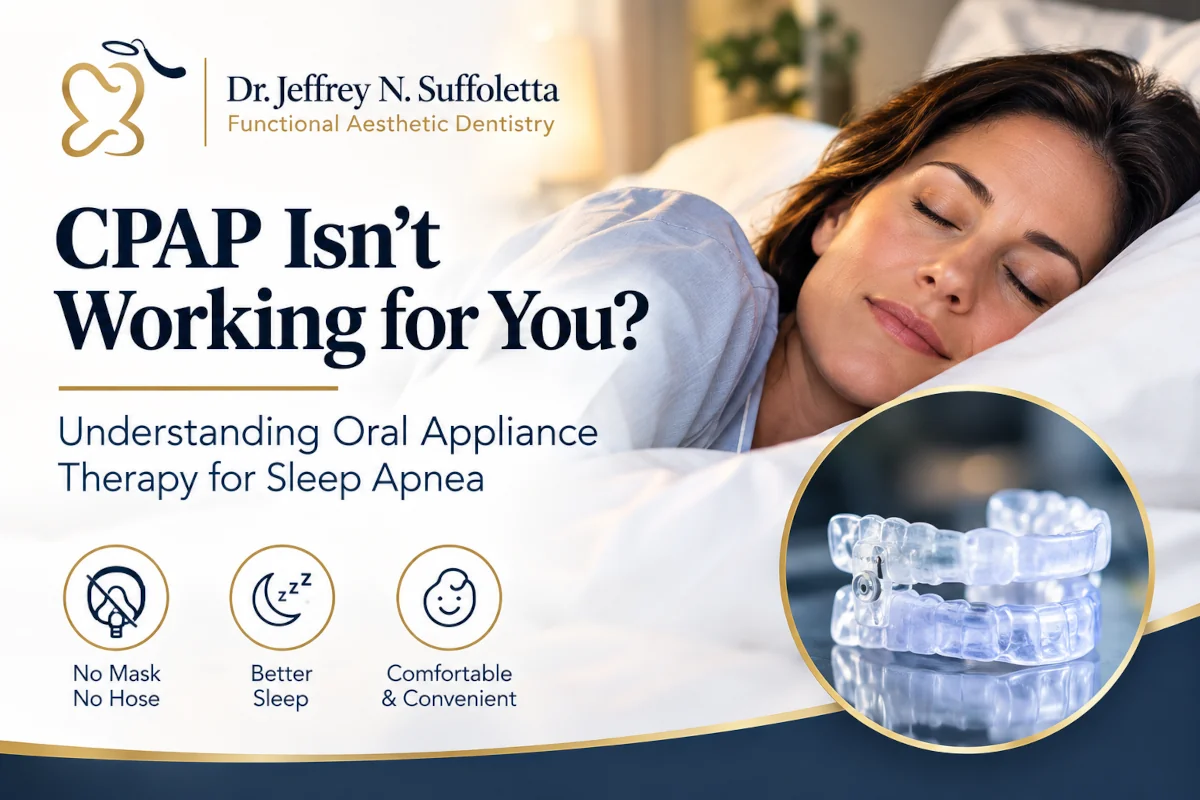
A sleep appliance for apnea is a custom device, fit to both arches, that holds the lower jaw slightly forward while you sleep. That posture tightens the muscles and soft tissue behind the tongue and keeps the airway from collapsing as easily. It is not a sports mouthguard. It is not the boil-and-bite snore piece in a pharmacy aisle. Those do not have a measured jaw position, a titration plan, or a dentist watching the bite.
The device is small enough to travel in a case. There is no hose and no motor. Side effects are real and belong in the consent: jaw soreness, tooth movement, a bite that feels different in the morning, drooling or dry mouth. Most of those are manageable if the starting position is conservative and the patient is seen back. Some are a reason to stop and return to CPAP or to a sleep surgeon.
How it differs from the machine, in practice
CPAP stents the airway with pressure. The appliance stents it with jaw position. CPAP can be titrated in fine pressure steps and, in many patients with severe apnea, still outperforms an appliance on the sleep study. The appliance wins on the nights it is worn when the mask would have been on the floor. Studies of preference and hours of use have generally favored oral appliances over PAP when patients are allowed to choose. Hours of use are the point. An excellent machine at zero hours treats nothing.
Portability is not a luxury feature. It is why some people stay treated on the road. The tradeoff is follow-up. An appliance that is never adjusted, and never checked against a repeat sleep study, is a guess.
Who it is for, and who it is not
Oral appliance therapy is used across mild, moderate, and severe obstructive sleep apnea, especially when PAP has failed or been refused. It is also used for primary snoring after a proper evaluation has ruled out significant apnea. It is not automatic.
It is a poor plan if there are not enough teeth to hold the device, if the gums and bone cannot tolerate the load, or if the jaw joint is already unstable. A patient with active temporomandibular pain needs that joint examined before anyone holds the mandible forward all night. Severe nasal obstruction, uncontrolled epilepsy, and a gag that will not accept any appliance are other reasons to pause. Central sleep apnea is a different disease; a jaw-position device is not its treatment.
A dentist does not diagnose obstructive sleep apnea. A physician does, usually with a home sleep test or a lab study. The dentist screens, builds and adjusts the appliance after that diagnosis, and sends the patient back so someone measures whether the apnea actually improved. The American Academy of Dental Sleep Medicine’s 2025 standards also draw a line on convenience: the exam, the scan or impressions, and the bite registration that sets the jaw position are in-person steps. A video visit can explain the device. It cannot fit it.
What the evaluation looks like
The first conversation is a history. Who prescribed the CPAP, how many nights it is worn, what specifically fails, whether anyone has seen pauses in breathing, whether mornings start with a headache or a sore jaw. A STOP-BANG style screen is useful. It is not a diagnosis.
The dental visit looks at teeth, restorations, gum health, how far the jaw can come forward without pain, and whether a device will dislodge a loose crown. If the joint clicks, locks, or already hurts, that finding can change the plan or delay it. Records—a digital scan and a bite at the starting protrusion—come next. The appliance is made, delivered, and advanced in small steps while the patient reports snoring, sleepiness, and jaw comfort.
Then the loop closes with the sleep physician. A follow-up study, or at least a structured check of symptoms and device data where that exists, is how you know the airway is open and not merely quieter to the person in the next bed. Quiet snoring with ongoing apnea is not success.
The goal is a treatment that gets used
Switching devices is not the win. Treated sleep is the win. For one patient that remains CPAP, after a different mask, a chin strap, or a month of real troubleshooting. For another it is an oral appliance worn seven nights a week, confirmed on a repeat study, with a bite that still fits at recall. For a third it is surgery, weight loss, or a combination. Dental offices that make these appliances should be able to say which of those paths they will not freelance.
If CPAP is in the closet, the useful next appointment is not a self-diagnosis. It is a conversation with the clinician who ordered the machine and, if an appliance is appropriate, a dentist who will examine the joint, fit the device in person, and send you back to have the result measured. The option exists. It is not for every airway. It is for the patient who has already learned that an unused machine is not care.