Why a Gentler Approach May Make a Difference
A cleaning is supposed to be the easy visit. For a lot of people it is the one they postpone. The tooth zings when cold water hits a receded root. The ultrasonic whine sets the jaw. A metal edge catches the gum and the rest of the hour is spent bracing. Skip enough of those visits and the thing that was only sensitive becomes a cavity, a loose crown, or a gum pocket that needs more than a polish.
Sensitivity is a reason to change the cleaning. It is not a reason to stop having one.
Why the standard visit hurts some mouths and not others
Enamel is a shell. Under it, dentin is full of tiny tubules that lead toward the nerve. When the gum pulls back, or enamel wears thin at the neck of the tooth, those tubules are open to cold, air, and touch. A scaler riding that root, an ultrasonic tip buzzing on it, or a rubber cup pressing paste into it is not “rough hygiene.” It is a stimulus on an unprotected surface.
Inflamed gums add a second problem. Tissue that already bleeds will not appreciate pressure. Patients who clench often have both: worn enamel at the gumline and muscles that tighten the moment the handpiece starts. The dread is learned. One bad visit trains the next one.
Traditional instruments are not the villain in every case. They are blunt tools for a job that used to be done entirely by contact. On a sensitive mouth, contact is the part that fails first.
A stream instead of an edge
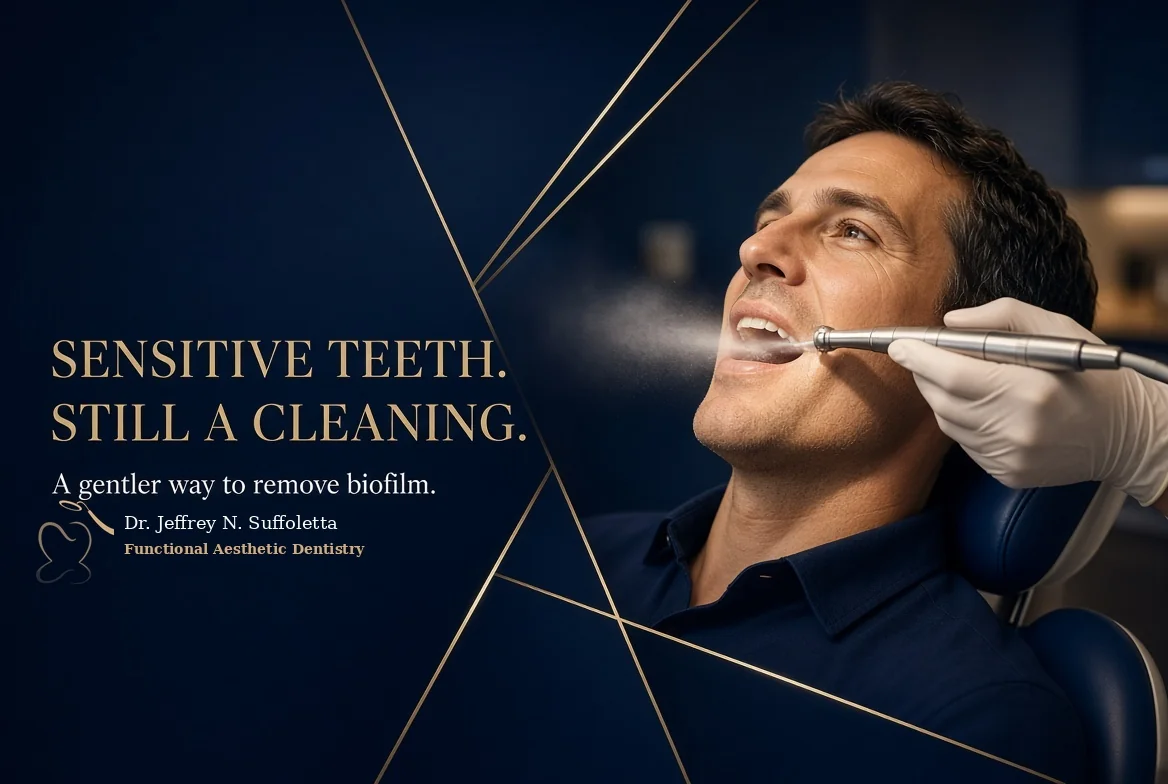
Air-polishing systems aim a mix of compressed air, warm water, and a fine powder at the tooth. In the protocol most offices now mean by this, the powder is erythritol milled to about 14 microns—much finer than the older bicarbonate powders used to blast stain. The slurry lifts biofilm, surface stain, and early soft deposits from enamel, along the gumline, under crown edges, and around implants.
Biofilm is the organized bacterial film that forms on a clean tooth within hours. It is what becomes plaque, then calculus, then the driver of gingivitis and, in the wrong patient, periodontitis. You cannot see most of it. Some hygienists disclose it with a dye so the patient can see the map before anything is removed. The powder stream is aimed at that film. It does not have to hook a metal tip under every contact to get there.
Warm water is a practical detail. Cold rinses on open dentin are a reliable way to end the visit early. Erythritol tastes faintly sweet rather than salty, which matters if the last air-polish you remember was a bicarbonate cleaning that felt like sand.
A trial of this approach plus ultrasonic cleaning, set against conventional scaling in patients already on periodontal maintenance, found similar improvements in plaque and bleeding, a few minutes less chair time, and better patient ratings for the air-polish visit. Comfort, in that study, did not cost effectiveness.
Gumlines are where the visit is won or lost
The sensitive zone is usually the last millimeter of enamel and the first millimeter of root. That is also where biofilm sits if the brush angle is wrong. A hygienist who treats every neck of every tooth with the same pressure will lose the patient who came in because of that exact spot.
Individualizing the visit means mapping the sensitive teeth before the scaler comes out, using the powder stream along those gumlines, and deciding—tooth by tooth—whether a hand instrument is required. Desensitizing varnish or a paste with potassium nitrate can go on at the end. A shorter session beats a heroic one that the patient will not repeat. Recession, ulcers, and a history of asthma are reasons to turn the spray down or skip it. The point is a plan, not a gadget on every surface.
Implants and restorations have their own rules
A crown margin, a veneer edge, and an implant collar collect biofilm exactly where a brush is weakest. They also punish the wrong instrument. Steel scalers and coarse bicarbonate can scratch titanium and dull a ceramic margin. Erythritol at this particle size is one of the methods studied for biofilm removal on implant surfaces without the roughening bicarbonate can cause. That does not make an implant maintenance-free. It makes the cleaning compatible with the material.
Implant patients and anyone with a lot of dentistry in the esthetic zone should hear this before the appointment, not after a scratch. Peri-implant mucositis—bleeding around an implant without bone loss—often starts as a cleaning that never quite reached the collar, or a collar nobody wanted to touch because the last instrument felt wrong. Gentle is not optional there. It is how the implant stays in the recall schedule.
Hard buildup still needs a real instrument
Powder removes biofilm and young, soft calculus. It does not dissolve mature tartar. Mineralized deposits still need an ultrasonic tip or a hand scaler, aimed at the deposit rather than used as a full-mouth default. The judgment is the hygienist’s: what is film, what is calculus, what is stain on a restoration that should not be abraded, what is a root so sensitive that today’s goal is disruption and a desensitizer, with the heavier scaling staged.
Technology does not retire that decision. It gives the hygienist a way to finish the soft half of the job before the hard half starts, so the hard half is shorter.
What to ask before you sit down
Is air-polishing with a fine erythritol powder part of the cleaning, or is the visit still scaler-first? Which teeth are you treating as sensitive, and will you avoid cold water and heavy pressure there? If I have crowns, veneers, or implants, what touches those surfaces? If calculus is left after the powder, how is it removed? Can a desensitizing varnish go on before I leave? If this visit is too much, can the rest be split?
Those questions are reasonable. An office that uses the technology should be able to answer them without a brochure.
Consistency beats a perfect hour
The cleaning that helps is the one that happens. Sensitive teeth are more likely to decay and more likely to be avoided. A visit built around air, warm water, and a fine powder—with scalers saved for what only they can move—will not suit every pocket and will not replace a toothbrush. It does remove the most common reason people give for stretching six months into eighteen. Preventive care only works if the patient comes back. Comfort is part of the treatment.