From 3D Printing to Same-Day Crowns
Dental restorations used to leave the office. A tooth was prepared, an impression was taken, a temporary crown was cemented, and a laboratory spent one to three weeks building the permanent piece. The patient came back, hoped the temporary was still on, and the final crown was seated. That sequence still happens. It is no longer the only sequence.
The newer story is digital. A scan replaces putty. Software designs the restoration. A machine in the office, or a printer down the hall, makes the part. 3D printing gets most of the headlines. It is only one branch of a larger shift: design and manufacture moved closer to the chair, and the question that matters is no longer “can we make this today?” It is “will this still be the right restoration in ten years?”
Where 3D printing is actually going
Printing models stopped being news years ago. Many offices now print study models, aligner setups, and surgical guides from a scan instead of pouring stone. That is useful. It is not a crown.
The next layer of printed work is already in clinical use. Printed dentures and partial frameworks are moving from lab curiosities to routine cases. Printed provisionals—temporary crowns and bridges—are common, because a provisional does not have to survive a decade of chewing. Occlusal splints and night guards are a natural fit: a printed or milled appliance can be remade if the bite changes. Some offices also print try-in veneers and mock-ups so a patient can see a shape before enamel is touched.
Long-term printed restorations are the unfinished chapter. Researchers have spent years trying to print zirconia, the ceramic many dentists prefer for back teeth, and finish it on a same-day clock. The bottleneck has been heat, not the printer. A printed zirconia crown comes off the machine as a fragile mix of ceramic particles and polymer binder. The binder has to be burned out slowly, or trapped gas cracks the part. Traditional debinding can take 20 to 100 hours. A 2025 paper from University of Texas at Dallas engineers, published in *Ceramics International* and widely discussed in 2026, described a single-step thermal process that cut debinding to under 30 minutes, using porous graphite felt and a vacuum to let gases escape. The researchers said a chairside printed zirconia crown could then be finished within a few hours.
That is a real engineering step. It is not a cleared, everyday product in a general practice. The group has said clinical validation and regulatory approval still sit between the furnace cycle and a routine patient visit. Printed resin “permanent” crowns are a separate category. They print fast and cost little in material. They are not zirconia, and a 2026 esthetic comparison noted that printed zirconia itself can be less translucent than milled zirconia of the same family. Speed is not the same claim as a decade of survival data.
Milling is not the old way. It is the proven digital way.
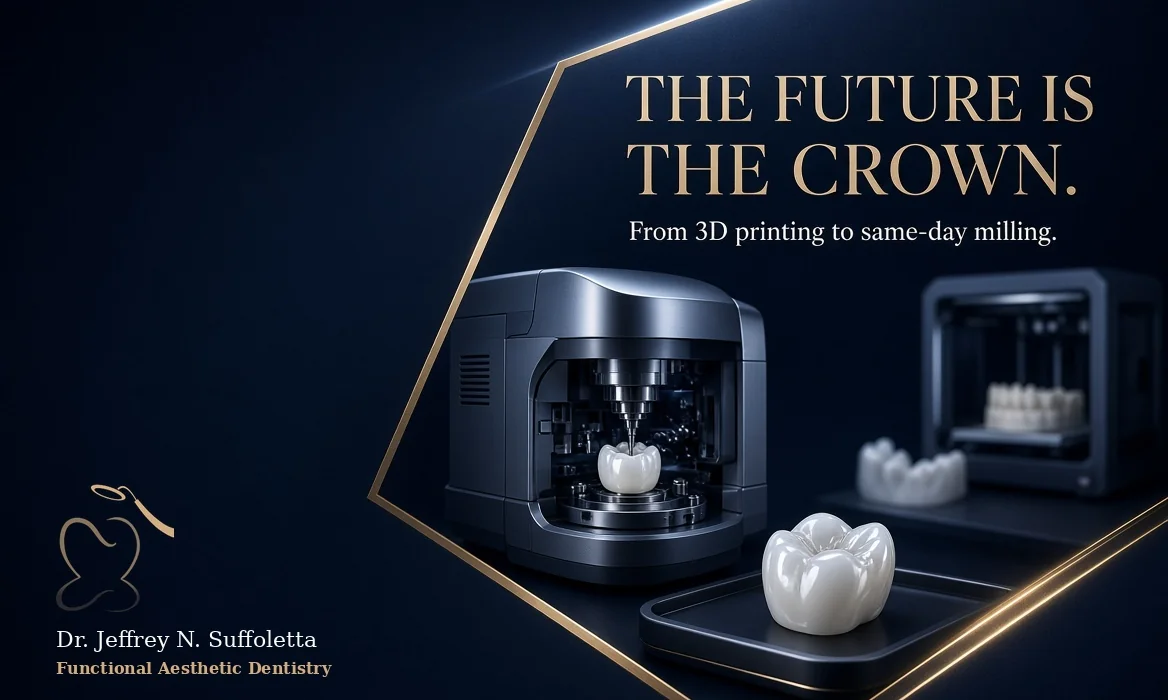
Digitally milled restorations start from a different object: a factory-made block of ceramic, already sintered or ready for a short glaze cycle. A chairside mill carves the crown out of that block from a digital design. CEREC, introduced in the 1980s and refined for decades, is the system most patients have heard of. Modern mills from several manufacturers do the same job. The appointment is often 90 minutes to three hours: numb, prepare, scan, design, mill for 10 to 40 minutes, try in, adjust the bite, bond.
The materials are the ones laboratories already trust. Lithium disilicate is the usual choice when translucency matters. Full-contour zirconia is the usual choice when the bite is heavy. Published chairside ceramic survival for single teeth has been reported in the mid-90s at four years and above 98 percent at seven years in some series. Those are not printer-brochure numbers. They are the record of a workflow that has been in mouths, not only in journals.
Milling has limits. A block is a single shade unless it is stained. Complex internal geometry wastes material. A dull bur or a bad scan still produces a crown that does not seat. Printing’s theoretical advantages—less waste, more intricate shapes, a crown “grown” rather than carved—are real on paper. They do not erase the clinical record milling already has.
A fast crown is not automatically a good crown
Production time is a patient convenience. It is not a success criterion. A restoration has to fit the margin so bacteria do not leak under it. It has to hold the bite so the tooth, the joint, and the opposing enamel are not overloaded. It has to be strong enough for that patient’s chewing, polished enough not to shred the tongue, and matched closely enough that the patient is not staring at it in every photo. It also has to be cemented or bonded correctly. Most crown failures start at the margin, the bite, or the cement line, not at the brand of the machine.
That is why “we can print it while you wait” is an incomplete sentence. A printed provisional that looks good for a month is a different product from a milled zirconia crown expected to function as a tooth. A lab-layered porcelain crown that takes two weeks can still be the better plan for a front tooth that needs custom shading. Digital dentistry widened the menu. It did not retire judgment.
What same-day actually changes for the patient
The practical gain is the missing middle chapter. No temporary that pops off on a bagel. No second numbing visit. No two weeks of chewing on the other side while a package moves between office and lab. Insurance generally treats a chairside ceramic crown as a ceramic crown; the code follows the restoration, not the machine. The visit is longer—plan on the better part of a morning or afternoon—and the patient leaves with the final piece if the fit is right.
In-office technology is what makes that possible: an intraoral scanner accurate enough to replace putty, design software that lets the dentist set contacts and occlusion before anything is cut, and a mill that can produce a crown from a proven block in the time it used to take to write a lab slip. The same digital file can also feed a printer for a model, a surgical guide, or a splint. The workflow is shared. The material decision is not.
Two decades of the one-hour restoration
Dr. Suffoletta has been delivering one-hour, long-term milled restorations for 20 years. That is not a pilot. It is a practice pattern: scan, design, mill, seat, and send the patient home with a final ceramic crown rather than a plastic cap and a return date. While research groups and manufacturers work toward a printed zirconia crown that can clear the same bar, milled crowns in this office have already been through the only test that counts—years of chewing, temperature change, and recall visits.
The distinction is worth stating plainly to a patient who has seen a trade-show video. Printing models is routine. Printing provisionals, dentures, and splints is expanding. Printing a permanent zirconia crown in the chair is a serious research project with commercial partners and a shortened furnace cycle, and it still needs the clinical record milling already has. A same-day final crown, in this practice, means a milled ceramic that has been in use for decades, finished in about an hour, and judged by fit and function before anyone leaves.
The future is performance, not the printer
Digital restorative dentistry will keep moving. Printers will get faster. Zirconia slurries will get more translucent. Some of today’s research crowns will become products, and some will not. Offices will mix the tools: mill the single crown, print the guide, send the layered front-tooth case to a technician who still does something software cannot.
The wrong finish line is “we printed it.” The right one is a restoration that fits, holds the bite, matches the mouth well enough, and is still there when the patient comes back. Same-day milling already meets that standard for many single teeth. Printing is earning its place beside it. It has not replaced it.