Why Finding a Treatment You Can Use Matters
A sleep-apnea diagnosis is a starting point, not a finish. The test shows that the airway is closing, oxygen is dropping, and the brain is pulling the sleeper out of rest over and over. What happens next depends on a less medical question: will the treatment still be in use on a Tuesday in March?
Obstructive sleep apnea is common, often quiet, and easy to file under snoring. Untreated, it is not a cosmetic problem. The pauses raise blood pressure, strain the heart, and leave people sleepy at the wheel and at the desk. The treatment with the best evidence for many patients is still CPAP. The treatment that protects them is the one they can stand to use.
What “untreated” actually costs
Each apnea is a brief collapse. Airflow stops or drops. Oxygen falls. The sleeper may not wake all the way, but the nervous system does. Heart rate jumps. Sleep fragments. In the morning the story is a dry mouth, a headache, or nothing at all—just the sense that eight hours did not work.
Over time, that pattern tracks with high blood pressure, atrial fibrillation, stroke risk, and harder-to-control blood sugar. Daytime sleepiness raises the chance of a crash. Mood and memory take a share of the blame that often gets assigned to stress. None of this means every snorer is in danger. It means a confirmed diagnosis that sits in a drawer is not neutral. The disease continues on the nights the machine stays off.
Why the machine gets abandoned
People stop CPAP for reasons that sound minor until you are the one wearing it. The mask leaks into the eyes. The straps mark the face. The nose dries out. The motor is a presence in the room even when the partner says they can sleep through it. Travel means a bag, distilled water, and an outlet that may not exist. Claustrophobia ends the trial on night one. Some patients wear it for the first half of the night and pull it off at 2 a.m., which is use on a download and not much of a treatment.
Lifestyle is the rest of it. A new baby, a night shift, a face that will not seal after weight change, a beard, a cold that blocks the nose for a month. Equipment hassles—supplies, cleaning, a pressure that was never rechecked—do the same job more slowly. The prescription is still active. The nights are not.
A device in the house is not a treated airway
Clinics often define adherence as a minimum number of hours on most nights. Patients define it as whether they can live with the thing. Both definitions matter, and they diverge. An excellent machine used for ninety minutes does not cover the second half of the night, which is when apnea is often worse. A quiet bedroom is not proof of open breathing. Partners notice snoring. They do not reliably notice silent pauses.
This is the practical failure the diagnosis does not solve by itself. An intervention can be medically sound and still leave the patient untreated if it never becomes a habit. The job after the sleep study is to match a proven option to a person who will still be using it when the novelty is gone.
Where an oral appliance fits, and where it does not
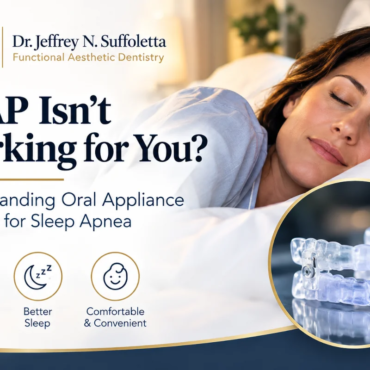
For some of those patients, a custom oral appliance is the match. It holds the lower jaw slightly forward so the tissue behind the tongue is less likely to collapse. No mask, no hose, no bedside unit. It travels in a case. Dental sleep standards, including those from the American Academy of Dental Sleep Medicine, support it across mild, moderate, and severe obstructive sleep apnea when positive airway pressure has failed, cannot be tolerated, or is declined—and for patients who prefer it. People who are succeeding with CPAP should stay with CPAP. The appliance is not a universal upgrade. It is an alternative with its own evidence and its own limits.
It is the wrong tool if there are not enough stable teeth, if the gums cannot hold the load, if the jaw joint is already painful or locking, or if the apnea is central rather than obstructive. A boil-and-bite guard from a store is not this treatment. Side effects—morning bite change, tooth movement, jaw soreness—are common enough that follow-up is part of the prescription, not an extra.
A dentist does not make the diagnosis. A physician does. The dentist examines the teeth and the joint, takes the records in person, and builds the device. A repeat sleep study, or a structured check with the sleep physician, is how anyone knows the pauses actually fell and not merely the noise.
The evaluation is two charts, not one
Severity matters. Mild apnea and severe apnea do not carry the same margin for a partial treatment. So does the rest of the history: blood pressure, heart rhythm, diabetes, sedative medications, alcohol at night, and whether anyone has watched the breathing stop. The dental side is separate and required: restorations that might loosen, gum disease, how far the jaw can come forward without pain, and whether a temporomandibular problem should be calmed before a device holds that jaw forward all night.
Coordination is the point the guidelines keep repeating. A sleep appliance made without a sleep diagnosis, or a CPAP prescription abandoned without telling the physician, leaves both offices guessing. The useful path is shared. The sleep clinician knows the apnea-hypopnea index and the oxygen dips. The dentist knows whether the mouth can hold an appliance. Neither number replaces the other.
A plan that survives a normal week
Sustainable means more than comfortable on the delivery day. It means the device is tolerable on a work night, packable on a trip, and still fitting six months later. It means someone asks about jaw pain instead of waiting for a tooth to move. It means the patient knows what success is—not “my partner says it’s quieter,” but a follow-up that looks at symptoms and, when appropriate, another sleep test.
Comfort, convenience, and lifestyle are not soft criteria. They are the reason adherence fails. A plan that ignores them will be medically elegant and practically unused. A plan that uses them as an excuse to skip measurement will be comfortable and possibly inadequate. Both errors leave the apnea in place.
The standard is appropriate and still in use
Untreated sleep apnea does not pause while a mask sits in a closet. Neither does it require every patient to endure a device they will not wear. The best plan is the one that fits the severity, respects the teeth and the jaw, and is still happening on an ordinary night. If CPAP is not that plan, the next conversation is with the clinician who ordered it—and, if an appliance is appropriate, with a dentist who will fit it properly and send you back to have the result checked. Diagnosis was the beginning. Use is the treatment.