How Technology Is Changing the Hygiene Experience
Most people still picture a dental cleaning as a metal hook, a high-pitched vibration, and a paste that tastes like chalk. The hygienist scales. The ultrasonic tip buzzes. Polish spins. You leave with clean teeth and a jaw that feels worked over. That picture is not wrong. It is incomplete.
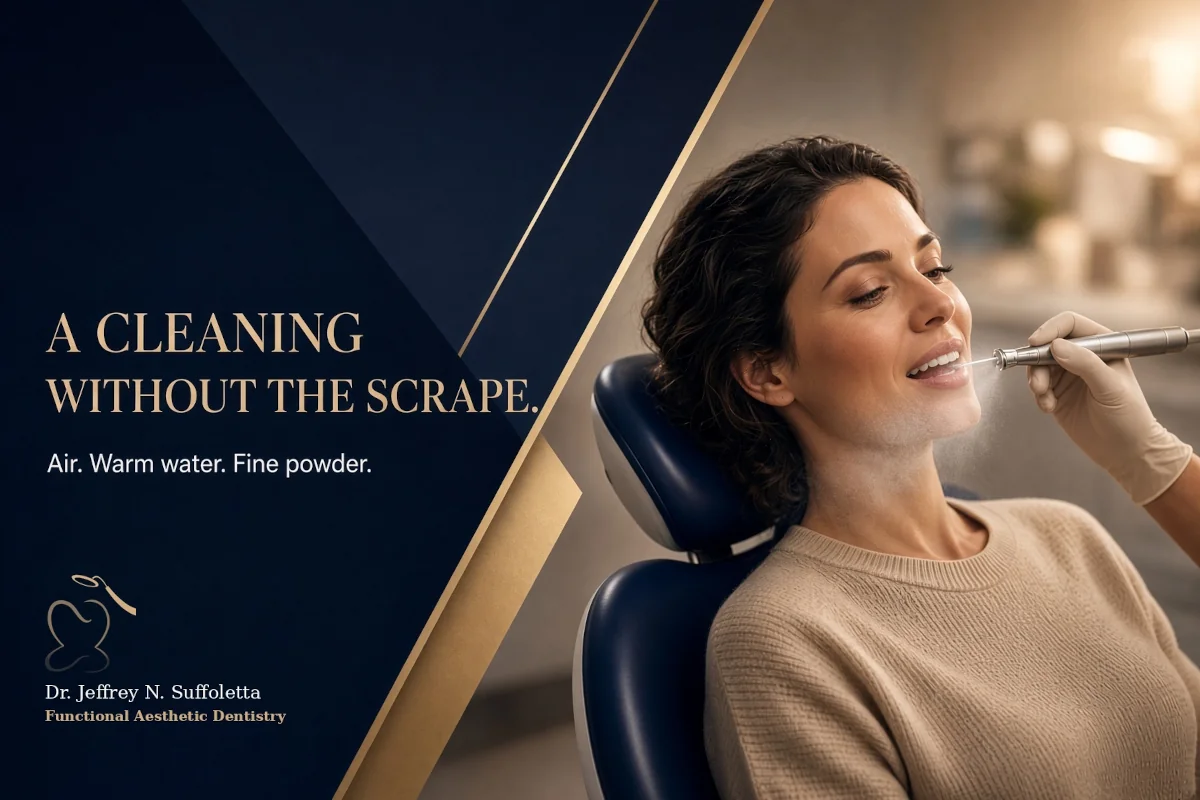
A growing number of offices now start the visit with a different tool: a controlled spray of air, warm water, and a very fine powder that lifts the soft film off teeth, gums, restorations, and implants before anyone reaches for a scaler. The goal is the same as it was in 1995—remove what causes decay and gum disease. The path there does not have to feel the same.
What the traditional cleaning still does
A standard prophylaxis has three jobs. Hand scalers catch hardened deposits the brush cannot move. An ultrasonic instrument uses vibration and water to break calculus and flush the pocket. A rubber cup and paste polish the enamel and take off surface stain.
Those tools remain necessary. Calculus—tartar—is mineralized plaque. Once it has hardened onto a tooth or a root, a gentle powder stream will not dissolve it. Deep pockets, heavy buildup, and infected root surfaces still need ultrasonic tips and, often, hand instruments. Polishing still has a place when stain is stubborn and the surface can tolerate it.
The change is sequence and dose. Modern hygiene tries to remove the soft problem first, with the least contact, and save the scaler for the deposits that actually require it. Patients who only remember the scrape are often remembering the part of the visit that used to do everything.
Air, warm water, and a 14-micron powder
Air-polishing systems such as EMS AIRFLOW mix compressed air, heated water, and a powder in a handpiece and aim the slurry at the tooth. The powder used in the current protocol is erythritol, a sugar alcohol already used as a food sweetener, milled to about 14 microns.
That is far finer than the sodium bicarbonate powders used in older “sandblasting” cleanings, which often ran around 40 microns and were salty, abrasive, and a poor idea on implants or delicate restorations.
The stream is meant to lift biofilm, early soft calculus, and surface stain from enamel, along the gumline, around crown margins, and in the shallow sulcus. Manufacturer guidance and clinical summaries describe use on natural teeth, restorations, orthodontic appliances, and implant surfaces, including the peri-implant sulcus, without the scratching associated with bicarbonate on titanium. Studies comparing erythritol and glycine powders with bicarbonate have generally found that the finer powders clean biofilm from implant surfaces without the surface roughening bicarbonate can cause.
This is not a substitute for an exam, X-rays, or periodontal charting. It is a way to remove the film that those findings are about.
What biofilm actually is
Plaque is not leftover food. It is a living layer. Bacteria in the mouth attach to a clean tooth within hours, build a sticky matrix, and organize into a community—biofilm. Brushing and flossing disrupt it. Whatever remains matures. Minerals from saliva can lock it into calculus. The same film along the gumline drives gingivitis. Below the gum, in a susceptible patient, it drives periodontitis. Around an implant, it drives mucositis and, if bone is lost, peri-implantitis.
You cannot see most of it. That is why some offices paint a disclosing dye on the teeth first, have the patient rinse, and then clean what the dye still marks. The color is a map. It also gives the hygienist a concrete way to show which spots the toothbrush is missing.
Removing that layer is the point of a cleaning. Scraping is only one method.
Why many patients describe the newer visit as easier
The powder stream does not rely on a metal edge riding the root. There is less of the vibration people associate with the ultrasonic, because the ultrasonic is reserved for calculus rather than used as the default on every surface. The tip reaches pits, contacts, the edge of a crown, and the collar of an implant without the hygienist having to hook a scaler into each one first.
Warm water matters more than it sounds. Cold rinses on exposed roots are a reliable way to make a sensitive patient dread the next recall. Erythritol is also mildly sweet rather than salty, which is a small thing until you have sat through a bicarbonate cleaning.
A randomized trial of Guided Biofilm Therapy—erythritol air-polishing plus piezoelectric ultrasonic, compared with conventional scaling and root planing in supportive periodontal care—found similar reductions in plaque and bleeding at six weeks, about five minutes less chair time, and a more favorable patient report for the air-polish protocol. That is not a promise of a spa visit. It is evidence that comfort and effectiveness are not opposites.
Sensitive teeth and inflamed gums still need a light hand. Recession, active ulcers, and uncontrolled asthma are reasons to adjust or skip the spray. A good office says so before the handpiece starts.
Calculus does not blast off
Young, soft deposits can come away with the powder. Mature calculus does not. It is bonded mineral. Expect the ultrasonic, and sometimes a hand scaler, once the biofilm is gone and the remaining deposits are visible. The difference patients notice is volume: less of the visit is metal-on-tooth, because the soft layer was already cleared.
Polishing paste is often unnecessary after erythritol air-polishing, which is itself a cleaning and a polish. That spares enamel a round of abrasion and spares patients the grit.
Who tends to notice the difference
People who have postponed cleanings because of sensitivity are the obvious group. So are patients with crowns, veneers, and bonding, where a coarse powder or an aggressive paste can dull a margin. Implant patients are a specific case. Titanium and its oxide layer should not be scratched by steel scalers or bicarbonate. A 14-micron erythritol stream is one of the methods designed for biofilm removal at the implant collar without that tradeoff. Orthodontic patients, with brackets that trap film a brush cannot reach, are another.
None of this replaces home care. Biofilm reforms. A comfortable cleaning that happens twice a year still loses to a mouth that is not cleaned daily. It does make the professional visit something more people will keep.
The cleaning is part of the experience, not only the treatment
Dentistry spent decades getting better at crowns, implants, and imaging. The hygiene hour is where most patients actually meet the practice. If that hour is still built entirely around scraping, a large share of adults will keep stretching the interval. Air, warm water, and a fine erythritol powder do not retire the scaler. They change when it is needed. The disease being treated is the same. The visit does not have to be.