Las Vegas Dentist is Leading the Way with Advanced Dental Technology
Dental care is changing quickly. Digital scanners, computer-designed restorations, laser dentistry, 3D imaging, and Invisalign® treatment planning are helping dentists provide care that is more precise, comfortable, and convenient. At Functional Aesthetic Dentistry in Las Vegas, Dr. Jeffrey N. Suffoletta combines advanced CEREC technology with a patient-centered approach. The goal is not simply to make treatment faster. It is to support healthier function, natural-looking results, and a more informed patient experience.
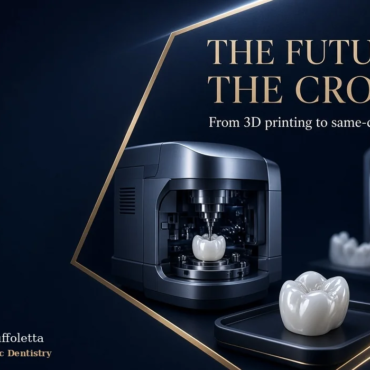
One of the most important examples is CEREC® same-day crown technology. Instead of waiting weeks for a dental laboratory to complete a crown, many appropriate patients can receive a custom restoration in one appointment.
Why digital dentistry matters in 2026
The need for restorative and cosmetic dentistry continues to grow. As more adults retain their natural teeth later in life, dentists are treating more worn, cracked, damaged, and heavily restored teeth. At the same time, patients are seeking cosmetic services such as veneers, whitening, clear aligners, and smile makeovers. These changing needs are encouraging dental practices to adopt digital workflows. A digital workflow connects diagnosis, treatment planning, design, fabrication, and follow-up through advanced imaging and computer technology.
For patients, this can mean:
- Fewer appointments for certain treatments
- More comfortable impressions
- Better communication with the dental team
- More predictable planning
- Faster production of restorations
- Improved coordination between function and aesthetics
Digital workflows and CEREC Technology does not replace a dentist’s clinical judgment. Instead, it gives the dentist more detailed information and better tools for making treatment decisions.
CEREC Technology for same-day crowns: how the process works
A traditional crown procedure often involves preparing the tooth, taking a physical impression, placing a temporary crown, and sending the case to an outside laboratory. The permanent crown may return in two or three weeks, requiring another appointment for placement. CEREC technology uses CAD/CAM technology to streamline this process. CAD means computer-aided design, while CAM means computer-aided manufacturing.
Here is how a typical CEREC technology crown workflow works.
The tooth is examined and prepared
First, Dr. Suffoletta evaluates the tooth to determine whether a crown is appropriate. A crown may be recommended when a tooth has substantial decay, a fracture, a large filling, or significant structural weakness. The damaged or weakened portions of the tooth are carefully removed. The preparation must provide enough space for the ceramic restoration while preserving as much healthy tooth structure as possible.
A digital optical impression is captured
Instead of using impression trays filled with putty, the dental team uses an intraoral scanner. This handheld device captures detailed optical images of the teeth and gums. The scanner gathers many images as it moves around the prepared tooth. Specialized software combines those images into a three-dimensional digital model. This approach can be especially helpful for patients with a sensitive gag reflex. There is no tray filled with impression material sitting in the mouth, and the scan can be paused if you need to swallow or take a break.
Digital impressions also reduce several problems associated with conventional impressions, including:
- Tearing or distortion of impression material
- Air bubbles or missing areas
- Errors caused by moving while the material sets
- Damage that can occur while a physical impression is being transported
The digital file can be reviewed immediately on a screen. If a portion is unclear, the team can rescan that area before moving forward.
The crown is designed with computer-aided software
The digital model is transferred into design software. Dr. Suffoletta and the dental team use this information to design the crown’s shape, size, contacts, bite relationship, and contours.
The design must do more than fill a space. It should work with the teeth around it and fit into your bite comfortably. The dentist also considers how the crown will support the surrounding teeth and contribute to the appearance of your smile. In some cases, digital design tools make it easier for patients to understand what is being planned. You may be able to view the tooth from different angles and see how the proposed restoration relates to the rest of your smile.
The restoration is milled on-site
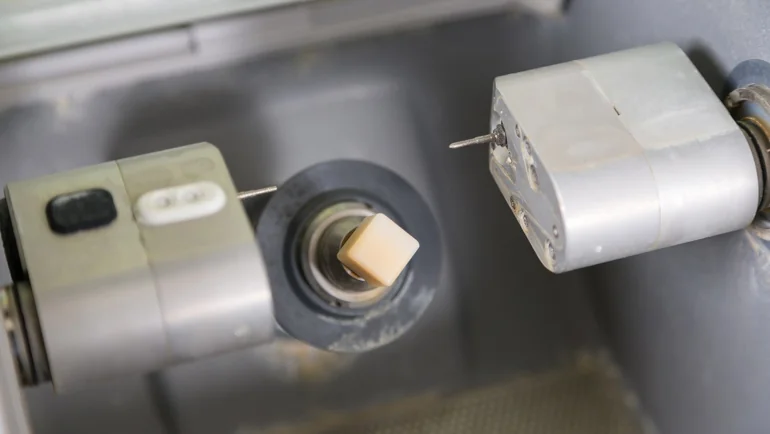
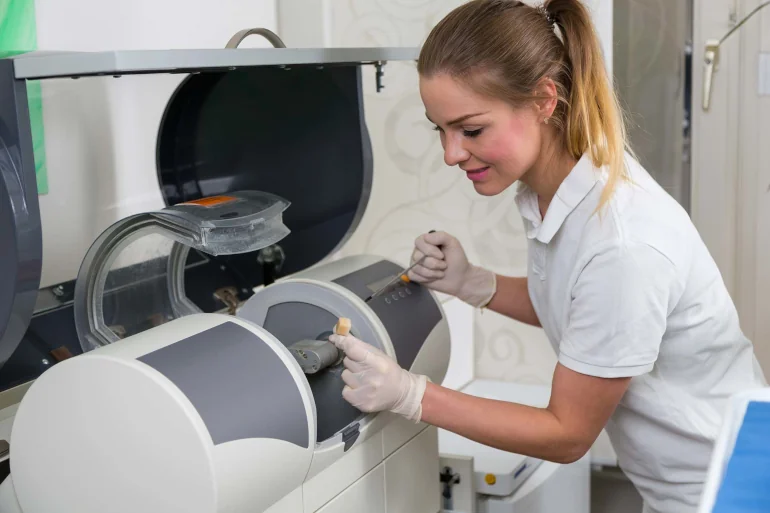
Once the design is complete, the information is sent to an on-site milling unit. The machine shapes a block of dental ceramic into the customized crown. Because milling takes place in the office, the restoration does not need to be shipped to an outside laboratory for the initial fabrication. This can shorten the overall treatment timeline from weeks to hours.
The color and appearance are refined
A natural-looking crown must match more than the general shade of the surrounding teeth. The dental team also considers translucency, brightness, surface texture, and how the restoration looks under different lighting conditions. The crown may be polished, characterized, or stained to achieve a more natural appearance. The final shade selection depends on the location of the tooth, the color of neighboring teeth, and your aesthetic goals.
The crown is tried in, adjusted, and bonded
Before the crown is permanently placed, it is checked in the mouth. The team evaluates its fit, shape, contacts with neighboring teeth, and relationship to your bite. If an adjustment is needed, it can often be made before bonding. Once the restoration fits properly, the tooth and ceramic are prepared for adhesion. A dental bonding system is used to secure the crown to the tooth. The result is a restoration designed to restore the tooth’s function while blending with your natural smile.
How CEREC compares with a traditional crown
CEREC is not automatically the right choice for every patient or every crown. Some complex cases may still be best completed through a conventional laboratory workflow. However, when a same-day crown is clinically appropriate, it can offer several practical advantages.
Avoiding a temporary crown may also reduce temporary sensitivity, loosening, or inconvenience. In addition, completing treatment in one visit can be valuable for patients with demanding schedules, those traveling to Las Vegas, or people who have difficulty taking time away from work.
Are CEREC crowns accurate and durable?
A common question is whether a crown made in a dental office can be as accurate and durable as one made in a laboratory. Research is encouraging, although results vary based on the material, scanner, design software, tooth preparation, bonding technique, and the dentist’s experience.
Studies comparing CAD/CAM crowns with conventionally fabricated crowns generally show that both methods can produce clinically acceptable marginal fit. The marginal fit describes how closely the edge of the crown meets the edge of the prepared tooth. A close fit helps limit areas where bacteria and plaque could collect.
Many studies use approximately 120 micrometers as a reference point for clinically acceptable marginal discrepancy. Research reviews have found that CEREC and other CAD/CAM crowns typically fall within accepted limits, with fit that is comparable to conventional laboratory restorations. Some studies show a slight advantage for digital methods, while others find no statistically significant difference.
Long-term survival is also generally comparable. Depending on the study and restoration type, published research has reported:
- Approximately 90% to 97% survival at five years for many CAD/CAM single-tooth restorations
- Approximately 89% to 90% survival at ten years in some long-term datasets
- Strong short- and medium-term results for modern lithium disilicate ceramic crowns
These figures describe groups of restorations, not a guarantee for an individual crown. A crown’s longevity depends on several factors, including:
- The amount of healthy tooth remaining
- The quality of the preparation and bonding
- Bite forces and tooth grinding
- Oral hygiene
- The type of ceramic selected
- Regular professional maintenance
For additional background, see this systematic review of ceramic crown fit and this long-term review of CAD/CAM restorations.
Other advanced technology at Functional Aesthetic Dentistry
CEREC is one part of a larger technology-supported approach.
Digital intraoral scanning
Digital scanners create three-dimensional models without conventional impression material. At Functional Aesthetic Dentistry, digital scans may support crowns, bridges, veneers, clear aligners, retainers, and nightguards. The scan can also help patients understand their oral health. Enlarged digital images make it easier to discuss worn enamel, fractured teeth, bite concerns, or cosmetic treatment options.
Read more about the FAD digital scan difference.