Enter the peptide revolution of enamel repair
For nearly a century, fluoride has been the undisputed heavyweight champion of the dental world. It’s in our water, our toothpaste, and those little foam trays that made us drool in the dentist’s chair as kids. But as we move further into 2026, the dental landscape is shifting. While fluoride is great at protecting what you have, it’s not exactly a “reset” button for enamel repair.
Enter the peptide revolution. If fluoride is the sturdy fence around your house, these new 2026 peptide breakthroughs are the expert contractors who show up to actually rebuild the walls. We are moving away from simply “maintaining” decay and toward a future of peptide-based enamel repair.
The March 2026 Breakthrough: Meet the TKH Peptide
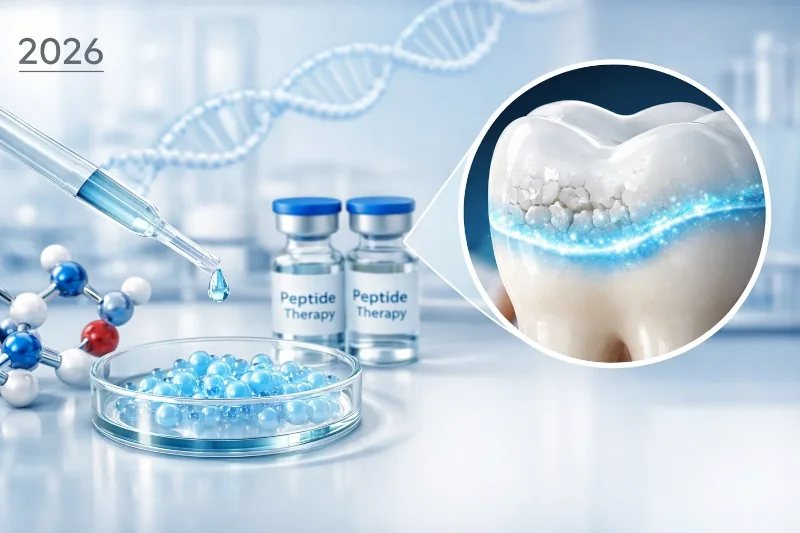
In early March 2026, a landmark study sent shockwaves through the dental community. Researchers identified a specific bioengineered α-hairpin peptide, known as TKH, which effectively acts as a biological “GPS” for minerals.
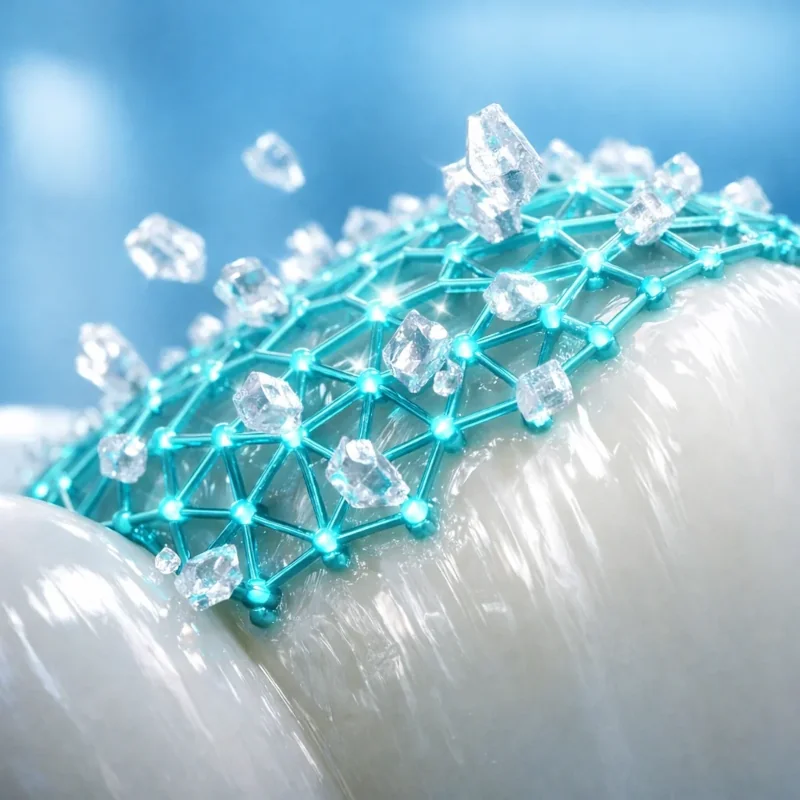
For years, the challenge has been getting minerals to stick to a tooth in a way that actually mimics nature. You can’t just glue some calcium to a tooth and call it a day; the body’s natural enamel is a complex, crystalline structure that is incredibly hard to replicate. However, the TKH peptide changes the game. It creates a molecular scaffold that guides calcium and phosphate ions into an organized, “epitaxial” growth pattern. In plain English? It helps your tooth grow its own enamel back.
This specific Nature study on TKH peptides highlights how these bioengineered proteins can seal exposed dentin tubules and regenerate demineralized layers within weeks, not months. This isn’t just a “coating”: it’s a biological integration.
Why “Biomimetic” is the Only Way Forward
At Functional Aesthetic Dentistry, we’ve always believed that nature got it right the first time. Our approach has long focused on biomimetic mineralization, a fancy way of saying we want to mimic the way a natural tooth is built.
Traditional dentistry often involves “drilling and filling.” If you have a cavity, we remove the decayed part and plug the hole with a foreign material. While modern fillings are better than the metal ones of the past, they are still a patch. Peptide-based enamel repair allows us to lean into a more natural solution. By using self-assembling peptides like the TKH or the P11-4 protein matrices, we can treat the tooth from the inside out.
The goal of our biocompatible and biomimetic dentistry is to preserve as much of your natural tooth structure as possible. When we use materials that behave like natural enamel and dentin, the tooth is less likely to crack, leak, or fail in the long run. The 2026 peptide innovations are simply the latest tools in our “nature-first” toolkit.
How Peptide-Based Enamel Repair Works (Simply Put)
To understand why this is such a big deal, we have to look at what enamel actually is. Enamel is the hardest substance in your body, but it’s essentially “dead” tissue: it doesn’t have cells to heal itself like your skin or bones do. Once it’s gone, it’s gone. Or at least, it was.
Peptide technology works through a three-step process:
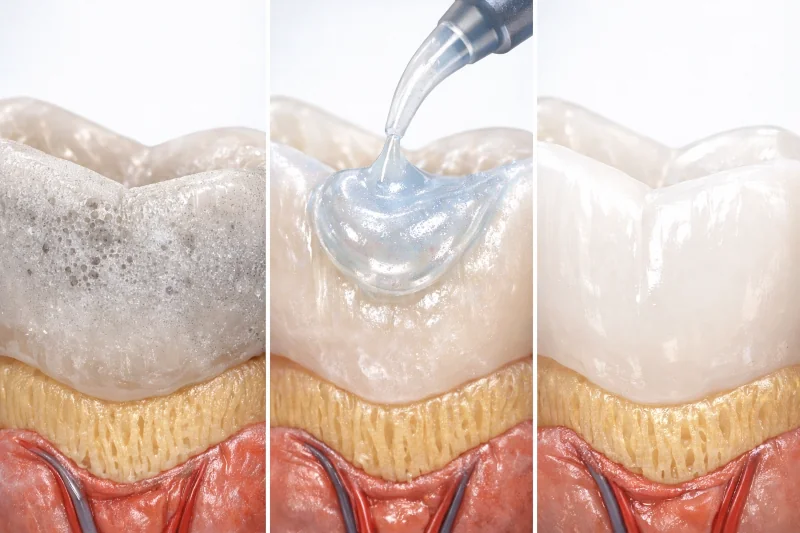
- The Scout: The peptide gel is applied to an early-stage cavity or a sensitive area. These peptides are designed to find the “holes” in your tooth’s mineral structure.
- The Scaffold: Once inside the lesion, the peptides self-assemble into a 3D network. Think of it like a biological skyscraper frame waiting for the concrete to be poured.
- The Mineralization: This scaffold attracts calcium and phosphate from your saliva (or a specialized rinse). These minerals crystallize onto the scaffold, creating new “hydroxyapatite”: the stuff real enamel is made of.
This process is what we call non-invasive cavity treatment. No drills, no needles, and no “numb face” for three hours after your appointment.
The End of “Zingers”: Solving Tooth Sensitivity
If you’ve ever winced while eating ice cream or taking a sip of hot coffee, you know the “zinger”: that sharp, lightning-bolt pain of tooth sensitivity. This usually happens when your enamel thins out and exposes the tiny tubes (tubules) in your dentin that lead straight to the nerve.
Traditional toothpastes for sensitive teeth work by either numbing the nerve or temporarily plugging those tubes. But those plugs wash away with acidic food or aggressive brushing. The 2026 peptide revolution offers a permanent solution. Because the TKH peptides actually grow new mineral layers over and inside those tubules, they seal the “hole” with actual tooth structure. It’s not a temporary fix; it’s a biological restoration.
Why This Matters for the 2026 Patient
You might be wondering, “Why haven’t I heard of this before?” The truth is, the technology has been in development for years (using proteins like amelogenin), but it is only now, in 2026, that the clinical application has caught up with the science.
Here is why our patients are getting excited:
- Early Detection is Rewarded: In the past, if we saw a “watch” (an area of early decay), we just had to wait for it to get big enough to fill. Now, we can treat those “watches” immediately with peptide therapy and stop the cavity before it ever starts.
- Reduced Anxiety: Let’s face it: most people don’t like the drill. The shift toward non-invasive cavity treatment means fewer “scary” procedures.
- Better Aesthetics: Because we are regenerating natural tooth structure, there’s no “mismatch” in color or texture. It’s your tooth, just better.
Whole-Body Health
By avoiding invasive procedures and using biocompatible peptides, we reduce the stress on your immune system and keep your mouth’s microbiome in balance.
The “Functional” Advantage
At Functional Aesthetic Dentistry, we don’t just look at your teeth in a vacuum. We look at how your oral health affects your sleep, your heart, and your overall energy. When we use advanced tech like the March 2026 peptide breakthroughs, we are choosing the path that is most harmonious with your body.
Fluoride will likely always have a place in the dental cabinet: it’s a great “shield.” But the future belongs to the “builders.” We are moving into an era where we don’t just stop decay; we reverse it. We don’t just manage sensitivity; we cure it.
What to Ask at Your Next Appointment
The next time you’re in the chair at our Summerlin office, don’t be afraid to ask about the “new stuff.” Dentistry is changing faster than ever, and 2026 is proving to be a landmark year for patient care.
If you have areas of sensitivity, or if you’ve been told you have a few “spots” that need watching, ask if peptide-based enamel repair is an option for you. It’s a casual conversation that could save you from a drill-and-fill appointment down the road.
Your teeth are designed to last a lifetime. With the help of some very smart proteins and a biomimetic approach, we’re making sure they actually do.
A Final Thought on the Peptide Revolution
As we embrace these 2026 innovations, the “Functional” in our name becomes even more important. It’s about more than just looking good; it’s about the biological integrity of your smile. The peptide revolution isn’t just a win for technology; it’s a win for the patient who wants to keep their natural teeth for as long as possible.
The drill isn’t going away entirely: sometimes a tooth needs a major overhaul: but for the first time in dental history, we have a way to help the body heal itself. And that is something worth smiling about.