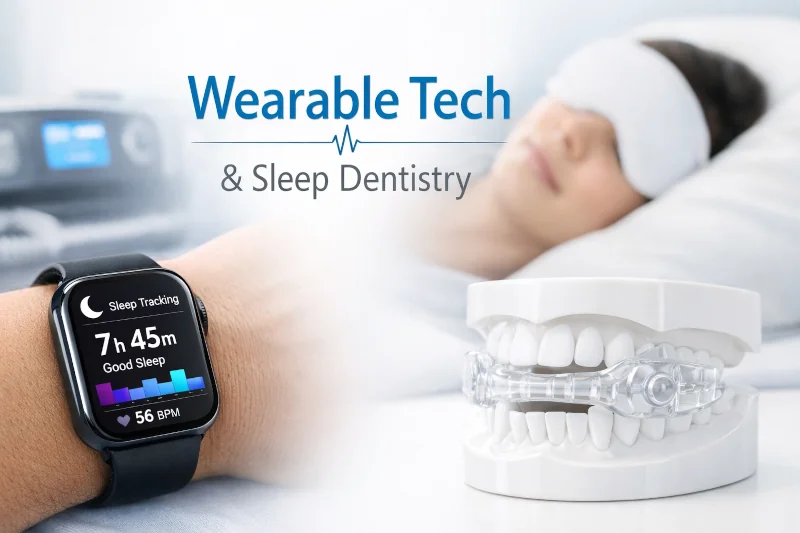
How Your Smartwatch is the Newest Tool for Sleep Dentistry
If you’re anything like the rest of Las Vegas in 2026, you probably don’t go to bed without your “biohacking” starter kit. Maybe it’s an Apple Watch Series 11 strapped to your wrist, a Garmin tracking your recovery, or an Oura Ring tucked neatly on your finger. We use these gadgets to track our steps, our calories, and even our stress levels during a particularly tense round of blackjack. But have you ever stopped to wonder why your dentist is suddenly so interested in your sleep data? Let’s talk about sleep dentistry!
At Functional Aesthetic Dentistry, we’ve moved way beyond the era of just poking at teeth and asking you to “open wide.” In the world of modern, tech-forward dental care, your wearable tech is actually the newest member of our diagnostic team. Your smartwatch isn’t just telling you that you had a “restless night”: it might be snitching on your jaw.
From teeth grinding to life-threatening sleep apnea, the data living on your smartphone is a goldmine for your oral health. Let’s dive into how wearable tech health data is changing the game for sleep apnea dentistry or sleep dentistry in Las Vegas.
Your Watch is a Sleep Detective (And Your Jaw is the Suspect)
For years, dentists had to rely on “patient self-reporting.” That’s a fancy way of saying we had to ask you, “Do you wake up with a headache?” or “Does your partner say you snore?” The problem? Most of us are terrible witnesses to our own sleep. You might think you slept like a baby, but your jaw tells a different story of a midnight boxing match.
In 2026, wearables have become sophisticated enough to pick up the slack. They track metrics that directly correlate with what’s happening in your mouth:
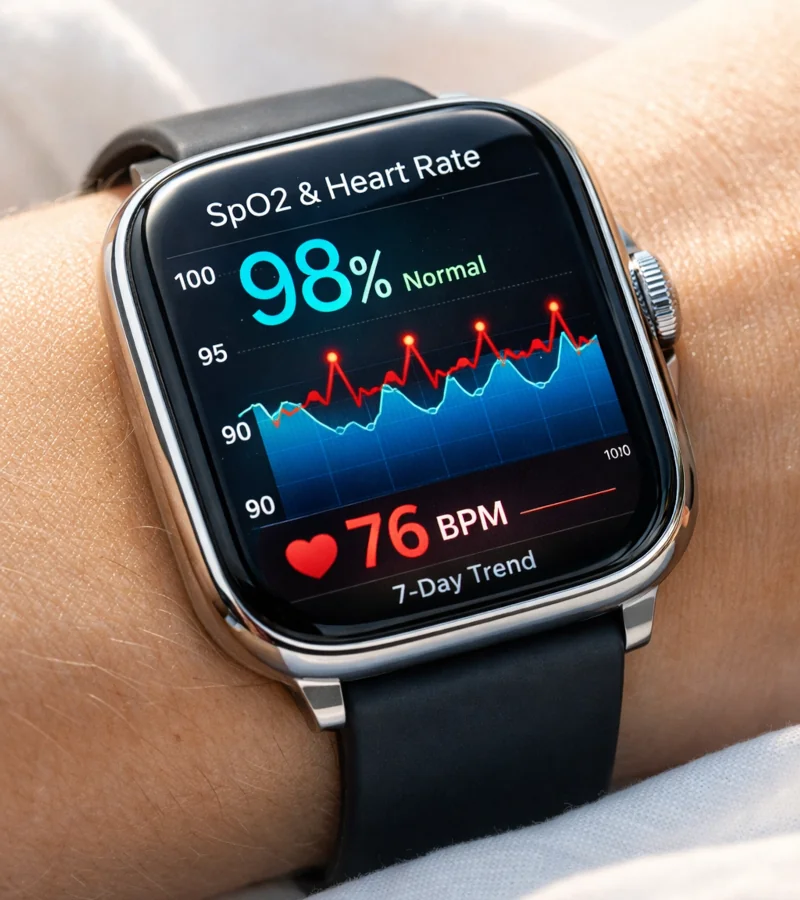
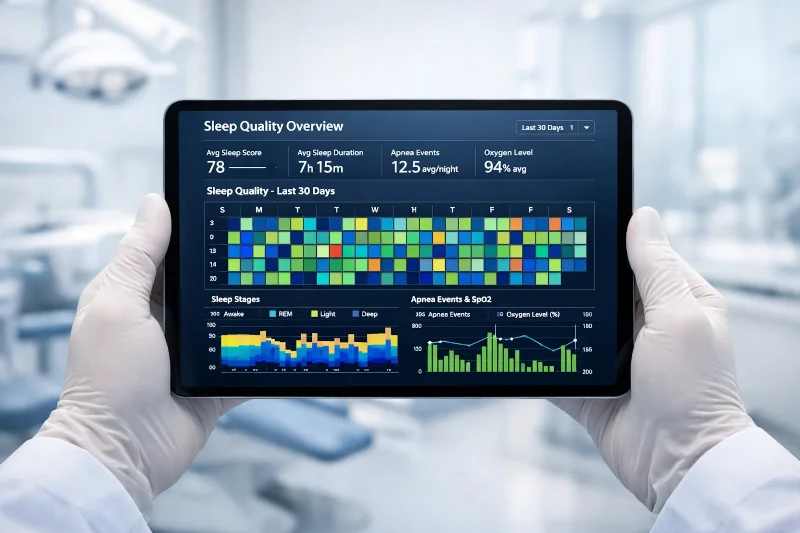
- Blood Oxygen Levels (SpO2): This is the big one for sleep apnea. If your watch shows your oxygen levels dipping significantly throughout the night, it’s a massive red flag that your airway might be collapsing.
- Heart Rate Variability (HRV) and Spikes: Did your heart rate suddenly jump at 3:00 AM while you were supposedly in deep sleep? That’s often a sign of “micro-arousals,” where your body jolts itself awake because it’s struggling to breathe.
- Movement and Restlessness: Constant tossing and turning is often linked to bruxism (teeth grinding) or an unstable jaw position.
Oura Ring Dental Integration: The Ultimate Hack for Sleep Dentistry
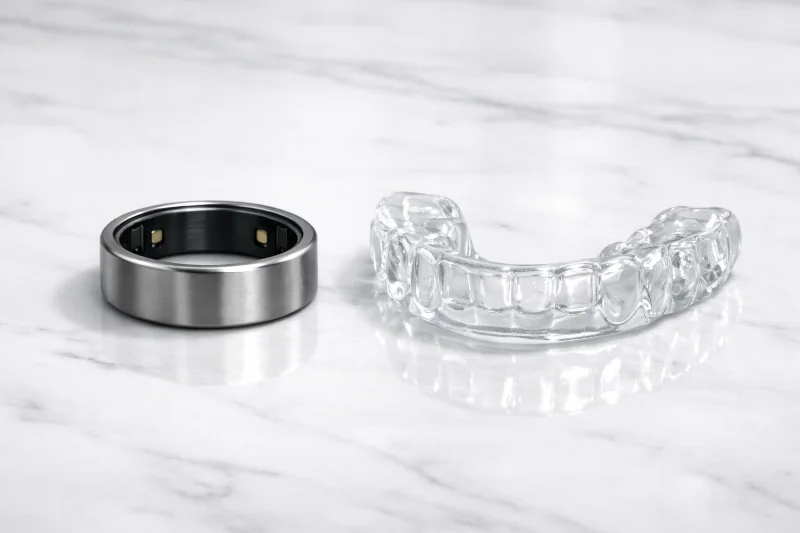
One of the most exciting developments we’ve seen recently is Oura ring dental integration. While smartwatches are great, many of our patients prefer the ring for its accuracy in tracking sleep stages without the bulk of a watch.
When you bring your Oura data into our office, we aren’t just looking at your “Sleep Score.” We’re looking at the “Stability” of your sleep. If the ring shows you are spending almost no time in REM sleep, but you’re spending plenty of time in bed, we start looking at your airway.
If your jaw is set too far back, or if your tongue is blocking your throat, your body stays in a “fight or flight” mode to keep you from suffocating. This state of high alert often leads to clenching. By the time you wake up, your Oura ring says you’re exhausted, and your teeth are literally worn down from the pressure. Using this data allows us to be proactive rather than reactive. Instead of waiting for you to crack a tooth, we can use your wearable data to suggest a custom night guard or an appliance that keeps your airway open.
Why Las Vegas Professionals Need to Pay Attention
Living in Las Vegas means living in a high-stress, high-performance environment. Whether you’re a high-stakes executive or a performer on the Strip, your body: and your mouth: takes the brunt of that “always-on” lifestyle. Stress is a leading cause of bruxism, and in a city that never sleeps, the quality of the sleep you do get is paramount.
We specialize in Functional Aesthetic Dentistry, which means we don’t just look at the aesthetics of your smile; we look at how your mouth functions within your whole body. If your wearable tech is shouting that you aren’t recovering, the culprit might be right under your nose (literally, it’s your jaw).
The 2026 Trend: From “Guessing” to “Knowing”
The dental industry is undergoing a massive shift. According to recent insights on 2026 trends in wearable tech, we are seeing a move toward “Continuous Patient Monitoring.” This means that instead of a one-time sleep study in a cold, clinical lab with wires glued to your head, we can look at thirty days of your real-life sleep data.
This continuous monitoring is vital because sleep isn’t a static event. Your sleep on a Tuesday after a workout is different from your sleep on a Saturday after a late dinner. By seeing the trends over time, we can create a treatment plan for sleep dentistry that actually fits your life.
How We Use Your Data During an Appointment
When you come in for a consultation, don’t be surprised if we ask to see your health app. Here’s what we’re looking for:
- Respiratory Rate Trends: A sudden increase in your breaths per minute during sleep can indicate that your body is working overtime to get oxygen.
- Deep Sleep vs. Light Sleep Ratio: If you’re getting zero deep sleep, we’re going to check your TMJ (temporomandibular joint) for signs of inflammation.
- The “Silent” Snore: Many wearables now record sound. If your watch is picking up “heavy breathing” or snoring, it’s a clinical indicator that we need to evaluate your airway.
Positioning Our Practice at the Tech Frontier
We get it: talking about “data integration” at the dentist sounds a bit like a sci-fi movie. But the reality is that this technology makes your life easier. It means fewer “guesser” appointments and more “solution” appointments.
By embracing wearable tech health data, we’ve positioned our practice as a tech-forward leader in Summerlin. We believe that the best dentistry happens when we have the most information. If your watch is telling us you’re struggling, we have the laser technology, the 3D imaging, and the functional expertise to fix it.
Is Your Smartwatch Trying to Tell You Something?
If you’ve been ignoring those “Poor Sleep” notifications on your wrist, it’s time to listen. Your body is trying to communicate, and often, the mouth is the primary spokesperson.
Common signs that your wearable data is pointing toward a dental issue include:
- Waking up with a “tight” or sore jaw.
- Chronic neck and shoulder tension.
- Teeth that look “shorter” or have jagged edges.
- Feeling like you need a nap by 2:00 PM despite “sleeping” 8 hours.
A Note of Caution: Tools, Not Doctors
As much as we love our gadgets, it is important to remember that an Apple Watch or an Oura ring is a screening tool, not a diagnostic tool. Your watch can’t officially diagnose you with Obstructive Sleep Apnea (OSA), but it can certainly provide the evidence needed to start the conversation. Think of your wearable as a smoke detector; it tells us there might be a fire, but you still need a professional to come in and find the source.
Sync Your Health, Save Your Smile
In 2026, your health is more integrated than ever. Your heart, your lungs, your sleep, and your teeth are all part of the same ecosystem. By utilizing wearable tech health data and specifically looking at Oura ring dental integration, we can help you achieve a level of health that was impossible just a decade ago.
Don’t wait until you’re dealing with a broken crown or chronic migraines. If your tech is showing you that your sleep is a mess, let’s take a look. We’re here to help you bridge the gap between your digital data and your physical well-being.
Bring your phone, bring your watch, and let’s get to work on the best version of your smile: and your sleep. After all, what happens in Vegas stays in Vegas… except for your sleep dentistry data. That stays on your wrist, and it’s time we used it for good.